


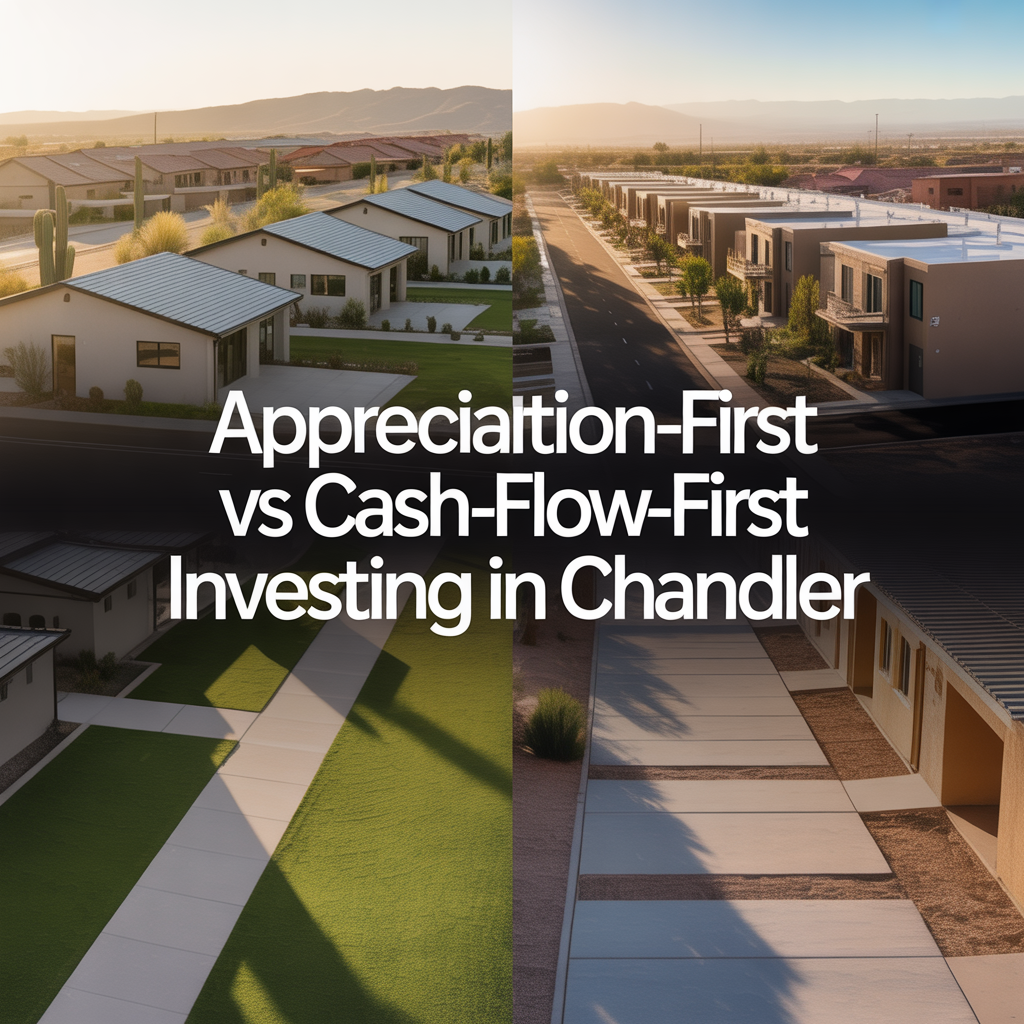
Chandler Lifestyle Guide → [Chandler Lifestyle Guide] & For more info on Chandler Real Estate → [Chandler Real Estate Guide]
Written by: Renee Burke
When you spend enough time around real estate investors in the Phoenix metro area, the conversation always seems to circle back to one question: Should I buy for appreciation or for cash flow? In other words, do you want a property that steadily puts money in your pocket every month, or one that quietly grows in long‑term value as Chandler continues evolving?
It’s not a simple “either‑or.” Chandler, like much of the East Valley, has its own rhythm — a blend of steady population growth, strong employment centers, and maturing neighborhoods that influence which investment approach makes sense for you.
Let’s break down what appreciation‑first and cash‑flow‑first investing look like here, how Chandler’s market and lifestyle tie into both, and what thoughtful investors are watching today.
Understanding Chandler’s Market Personality
Chandler isn’t a speculative market anymore — it’s a city that’s grown up gracefully. Once mostly suburban sprawl, it’s now a hub for technology, advanced manufacturing, and quality‑of‑life living. Companies like Intel, Microchip Technology, and Northrop Grumman have firmly planted roots here, drawing in a highly skilled workforce that values good schools, newer housing, and easy access to amenities.
That kind of stability tends to support appreciation over time. When you have consistent job growth, top‑rated schools, and limited new land for development, property values naturally push upward. Whether you’re buying in Fulton Ranch, Ocotillo, or even some of Chandler’s more modest legacy neighborhoods, there’s an underlying confidence that your investment will mature gracefully.
But steady appreciation doesn’t always mean strong immediate cash flow. That’s where you start to feel the pull between two philosophies: growth today vs. income today.
The Appreciation‑First Mindset
Appreciation‑focused investors in Chandler often look beyond the immediate rent‑to‑mortgage balance. They’re looking at quality — neighborhoods with excellent school districts, low turnover, and solid long‑term desirability. These are the homes renters naturally want to stay in, and buyers eventually compete for.
An appreciation‑first investor might choose:
- A 4‑bedroom home in Fulton Ranch or Ocotillo, perhaps newer construction with a modern floor plan.
- A location near tech employers or executive corridors, where pricing is resilient even during soft markets.
- A property that may only produce modest monthly cash flow (or even break even initially) because they’re banking on year‑over‑year growth in value.
The attraction lies in Chandler’s strong fundamentals: highly educated population, diversified employment, and strong lifestyle appeal. When Silicon Desert headlines remind the world that Phoenix is on the map for semiconductor expansion, Chandler benefits directly.
Appreciation‑first investors see Chandler not as a place to squeeze profit each month, but as a safe, appreciating cornerstone of a balanced portfolio.
The Cash‑Flow‑First Approach
Cash‑flow‑driven investors think differently. Their goal is predictable income — ideally from day one. They tend to prioritize purchase price, rent ratios, and low maintenance costs above all else.
In Chandler, finding pure cash‑flow deals can be tricky. Home prices, particularly in newer subdivisions, are higher than other East Valley communities like Mesa or parts of Queen Creek. Rents, though strong, don’t always keep up at the same pace.
That said, there are opportunities when you look carefully. Cash‑flow investors often explore:
- Slightly older homes in central Chandler or lower‑turnover pockets north of the 202.
- Properties that may need light cosmetic updates, allowing rent premiums after improvements.
- Smaller multifamily or duplex opportunities, where shared expenses and higher density can enhance yield.
Cash‑flow investors operating here usually accept slimmer margins upfront but plan to hold long enough for rents to catch up naturally. As Chandler’s rental demand continues to outpace new supply, those numbers tend to evolve in your favor.
The Local Lifestyle Factor
Something that’s often missed in textbook investment analysis is how the people who live here actually live. Chandler isn’t just a grid of subdivisions. It’s a real community — families meeting at Veterans Oasis Park on weekends, professionals enjoying Ocotillo’s canalside patios, and retirees drawn by the city’s easy warmth and safety.
When a city’s lifestyle is this strong, appreciation has deeper roots. People buy into Chandler not just for the house, but for the structure of daily life: short commutes to tech campuses, proximity to dining and recreation, and the peace of stable neighborhoods.
That’s why the appreciation story in Chandler feels less speculative than in trendier pockets of Phoenix or Tempe. It’s lifestyle‑anchored — built on real people who plan to stay.
But that same lifestyle attractiveness pressures rent growth, too. Even tenants want “nice,” and they know good Chandler rentals are competitive. The better you understand these local rhythms, the more strategically you can balance appreciation and income priorities.
How Market Cycles Influence Each Strategy
Every market moves in cycles, and even in fast‑growing Phoenix, momentum can shift. When mortgage rates rise, cash‑flow properties tend to hold investor interest because they offer more immediate reward. When rates fall or employment expands sharply, appreciation markets often accelerate because buyers stretch for higher‑priced, high‑quality homes.
Right now, Chandler sits in that interesting middle ground. After the rapid gains of 2020–2022 and a cooling period since mid‑2023, prices have stabilized but remain well above pre‑pandemic levels. Rents have steadied too, but haven’t declined meaningfully — a sign of healthy underlying demand.
From an investor’s lens, that means neither strategy is wrong. If you favor long‑term wealth building with manageable risk, leaning into appreciation‑ready neighborhoods remains wise. If you want portfolio stability and immediate monthly performance, a sharper eye toward value‑priced Chandler pockets or small multi‑unit holdings could be ideal.
The smartest investors often layer both — beginning with modest cash flow today but choosing properties positioned for organic appreciation tomorrow.
Weaving Both Philosophies Together
Many seasoned investors in the Phoenix metro have learned that the best strategy isn’t about choosing sides — it’s about sequencing. You can start with cash‑flow investments to build income stability, then reinvest profits into higher‑appreciation markets like Chandler as your base strengthens.
Chandler serves beautifully as a “next stage” market. Once investors cut their teeth in slightly more affordable nearby cities, they often move here for the reliability: newer homes, excellent schools, quality tenants, and fewer surprises.
And if you already own in Chandler, you may find it’s your anchor — the property whose long‑term rise offsets any short‑term dips elsewhere.
It comes down to alignment with your goals and temperament. If seeing monthly profits calms your nerves, favor cash flow first. If you’re patient and comfortable with time doing the heavy lifting, Chandler’s appreciation profile serves you well.
There’s no wrong choice when you’re matching the rhythm of your investment to the city’s natural pace.
Common Misconceptions
Many would‑be investors hesitate on Chandler because they’ve heard “it’s too expensive” or “the cash flow doesn’t work.” The truth depends entirely on perspective.
Yes, buying into Chandler requires more capital upfront — but investors often underestimate how much risk reduction that stability provides. Vacancy rates are consistently low, tenant quality is higher, and property maintenance is gentler simply because most homes are newer and built to stronger codes.
Another misconception: that appreciation plays are “speculative.” In truth, Chandler’s economy is anchored by diverse employers, well‑funded city planning, and a population that continues to grow by choice. You don’t need hype to expect property values here to rise steadily — just patience and sound management.
What to Watch Moving Forward
As we look deeper into 2026, three factors will shape how appreciation‑first and cash‑flow‑first investing balance out in Chandler:
- Interest Rate Movement – Declining rates could reopen affordability and ignite another appreciation cycle, particularly in desirable communities like Ocotillo and Fulton Ranch.
- Employer Expansion – If Intel’s ongoing developments continue drawing high‑salary recruits, the upper‑end rental and resale market will tighten further.
- Municipal Growth Planning – Chandler’s thoughtful zoning and emphasis on maintaining lifestyle quality will limit oversupply and protect long‑term values.
Keeping these in view helps you time decisions wisely without chasing short‑term trends.
A Grounded, Local Takeaway
At its heart, Chandler invites the kind of investing that feels human — rooted in livability and steady progress. Whether your spreadsheet favors cash flow or your heart leans toward gradual value growth, remember that the city’s strength lies in balance.
Walk its neighborhoods on a warm February evening and you’ll sense it: the hum of a place that’s still growing, still maturing, but already deeply established. That’s what long‑term wealth feels like — not flashy, not speculative, just enduring.
A Warm Invitation
If you’re thinking about how Chandler fits into your investment picture, you don’t have to figure it out alone. Every investor’s path looks a little different, and your comfort level, goals, and timing all matter just as much as market numbers.
I’ve guided clients across Phoenix through these kinds of decisions for years — not with pressure, but with perspective. If you’d like to talk through where appreciation or cash flow best aligns with your next step, I’d be honored to help you plan the route that feels right for you.
Get the full Phoenix Market Insights → [Market Insights]


-
Cost of Living in Rhode Island: Housing, Taxes, Utilities, and Everyday Expenses
-

What If My Commute Becomes Worse Than Expected?
-

How Aging Home Systems Affect Property Value
-

Energy Efficiency Upgrades for Phoenix Homes
-
How to Plan for Major Home System Replacements
-

When Phoenix Homeowners Should Replace Water Heaters
-

Repair vs Replace Decisions for Phoenix HVAC Systems
-
Creating a Long-Term Home Maintenance Plan
-

How Often Phoenix Homes Should Be Professionally Inspected
-
Early Warning Signs of Major Home System Failures
-

How Preventative Maintenance Protects Phoenix Property Value
-

The Best Annual Home Maintenance Plan for Phoenix Homes
-

Electrical Safety Inspections for Older Phoenix Homes
-

Why Whole-Home Surge Protection Matters in Arizona
-

Preparing a Phoenix Home for Electric Vehicle Charging
-

Signs Your Home’s Electrical System Is Overloaded
-
When Phoenix Homes Need Electrical Panel Upgrades
-

Water Pressure Problems in Phoenix Homes Explained
-

Preventing Irrigation Leaks That Waste Water in Desert Landscapes
-

Signs of Hidden Plumbing Leaks in Phoenix Houses
-

How Long Water Heaters Last in Arizona Homes
-

How Hard Water Affects Plumbing Systems in Phoenix Homes
-

Preventing Water Damage in Phoenix Homes During Storms
-

Roof Maintenance Tips Before Phoenix Monsoon Season
-

How Arizona Sun Damages Roofing Materials Over Time