


Local Politics and Housing→ [Local Politics and Housing] & For more info on National Politics and Housing → [National Politics and Housing]
Written by: Renee Burke
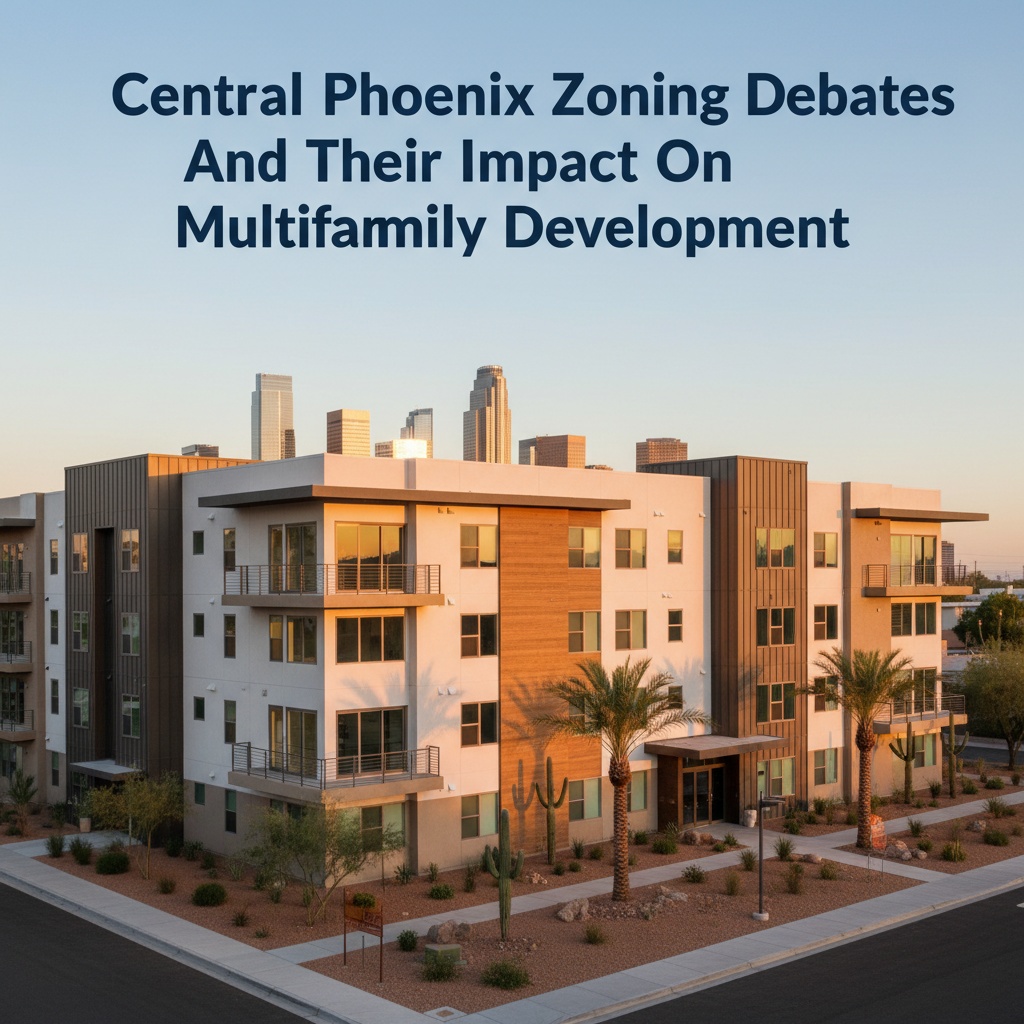
Central Phoenix zoning debates really come down to a tug‑of‑war between three forces: state‑driven push for more housing, city‑level efforts to manage form and character, and neighborhood concerns about scale, traffic, and historic fabric.
Those cross‑currents directly influence what kind of multifamily actually gets built, where it lands, and how quickly projects move from concept to construction.
The New Middle‑Housing Overlay Around Downtown
A big piece of the current debate is Phoenix’s response to Arizona’s “middle housing” law, HB2721, which requires larger cities to allow duplexes, triplexes, fourplexes, and townhomes on single‑family lots within about a mile of their central business district.
Phoenix translated that state mandate into the Middle Housing Overlay District (MHOD) via text amendment Z‑TA‑1‑25‑Y:
- It allows up to four units per lot on previously single‑family parcels in a one‑mile belt around Downtown, treating them as small‑scale multifamily so long as they resemble single‑family in height and form.
- It is tied to a companion rezoning (Z‑3‑25‑4‑7‑8) that maps the overlay specifically in central areas with strong job access and transit.
For multifamily developers, this doesn’t create high‑rise zoning overnight, but it does open the door for small, infill multiplexes and townhome clusters in locations that used to be effectively off‑limits. That’s a quiet but important shift in where units can pencil in Central Phoenix.
State vs. Local: How HB2721 Shapes Central Phoenix
HB2721 sets the broad rules; Phoenix decides how aggressively to interpret them.
Key implications for multifamily:
- By right up to four units on eligible lots within the overlay dramatically simplifies entitlement compared with a full rezoning, which historically meant neighborhood meetings, hearings, and potential appeals.
- If Phoenix ultimately embraces a target around 20 dwelling units per acre in these areas—as some urban advocates have urged—developers can reliably underwrite low‑rise apartments, fourplexes, and townhome rows near the core without betting on variances or upzoning.
- Parking flexibility and the ability to leverage existing city garages downtown could improve condo and small multifamily feasibility in some central corridors.
In practice, that means Central Phoenix is becoming more overlay‑driven: the base zoning might still read “single‑family,” but the overlay quietly invites missing‑middle multifamily into the fabric.
Historic Neighborhoods: The Flashpoint Limiting Multifamily
Historic districts just north and west of downtown—like Willo and others—sit squarely inside the one‑mile belt and see themselves as ground zero for the new rules.
Preservation advocates worry that:
- The combination of HB2721 and the MHOD will incentivize teardowns of contributing historic homes, replacing them with higher‑yield middle‑housing projects.
- Since historic designation depends on maintaining a majority of contributing structures (often 51% or more), too many demolitions could threaten district status over time.
This has already led to political moves:
- A bill (HB 2375) seeks to exempt historic neighborhoods from the middle‑housing mandate, effectively carving them out of the state requirement and limiting by‑right multifamily intensification there.
For multifamily developers, this means Central Phoenix is not a uniform canvas. Blocks inside historic overlays may remain largely off‑limits to new small‑scale multifamily, even as nearby non‑historic blocks become more flexible.
Traditional Multifamily Zoning and Height Controls
Outside the middle‑housing conversation, Central Phoenix still runs on its traditional multifamily districts—R‑2, R‑3, R‑4, R‑5, and various mixed‑use/urban overlays—which control:
- Height and density, determining whether a site supports garden‑style, mid‑rise, or more urban product.
- Setbacks, open‑space, and parking ratios, which shape project massing and feasibility.
Recent trends in those debates include:
- Pushback on very tall projects abutting established single‑family or historic areas, with neighbors raising concerns about shade, privacy, and traffic.
- Pressure for more mixed‑use and active ground floors along central corridors, which can increase costs but also improve absorption and long‑term value.
The result is that large multifamily in Central Phoenix tends to cluster along arterials and transit‑rich corridors, with scale stepping down toward neighborhoods that are more politically organized or historically protected.
How These Debates Affect Project Feasibility and Timing
From a practical standpoint, zoning debates in Central Phoenix affect multifamily in three main ways:
- Site Selection and Assemblage
- Developers increasingly favor parcels where zoning or overlays already support desired density, rather than betting on contentious upzonings near historic districts.
- Corner lots and edge parcels at the interface of commercial and residential zones become especially attractive for missing‑middle or low‑rise multifamily.
- Entitlement Risk and Holding Costs
- Parcels in or near historic districts can face longer, more uncertain entitlement paths if exemptions or added protections advance, increasing soft costs and risk premiums.
- Conversely, sites fully inside the MHOD but outside historic overlays can move more quickly with by‑right middle‑housing, shortening timelines for small multifamily projects.
- Product Mix and Design Strategy
- In sensitive areas, developers leaning into 2–3 story, context‑sensitive designs (pitched roofs, setbacks, heavy landscaping) are more likely to win support and avoid appeals.
- Along core transit and employment corridors, there’s more room for mid‑rise multifamily, but expectations around design, ground‑floor activation, and parking management are higher.
In short: Central Phoenix zoning debates don’t shut the door on multifamily—they push it toward more nuanced, context‑driven projects and reward teams that can navigate both the letter of the code and the politics behind it.
A Warm Closing From Renee
If you’re looking at multifamily opportunities in Central Phoenix—whether that’s a small fourplex site or a larger infill parcel—it’s completely normal to feel like the zoning landscape is shifting under your feet. Between new middle‑housing rules, historic protections, and neighborhood voices, the map is more layered than ever.
You don’t have to sort through that alone. This is the kind of block‑by‑block, overlay‑by‑overlay work I live in every day—where a line on a zoning map can mean the difference between a smooth path and a years‑long entitlement fight.
If you’re thinking about making a move in Phoenix, you don’t have to figure it out alone. Reach out anytime, and we’ll walk through specific central neighborhoods, decode their zoning stories, and match you with multifamily opportunities that fit both your goals and the reality on the ground.
Get the full Phoenix Market Insights → [Market Insights]


-
Cost of Living in Rhode Island: Housing, Taxes, Utilities, and Everyday Expenses
-

What If My Commute Becomes Worse Than Expected?
-

How Aging Home Systems Affect Property Value