


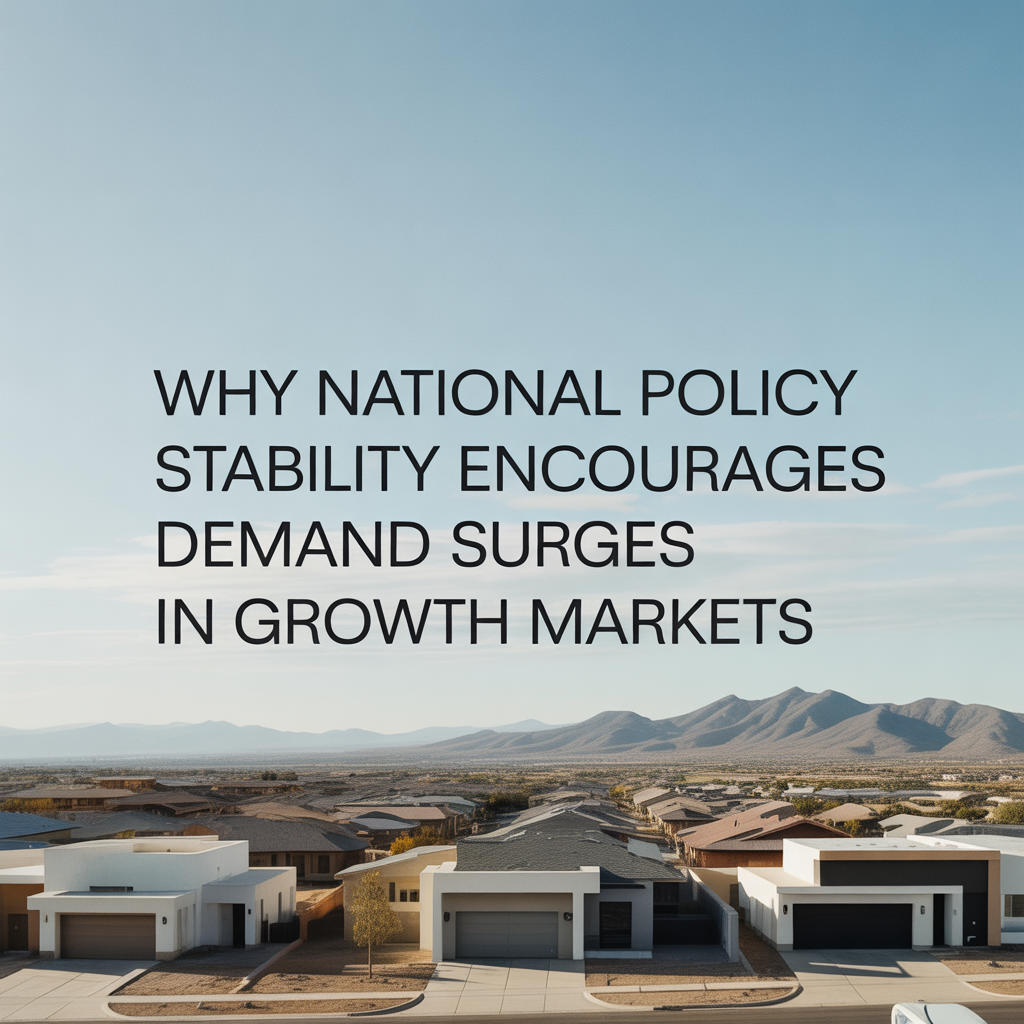
National Politics and Housing → [National Politics and Housing] & For more info on Local Politics and Housing→ [Local Politics and Housing]
Written by: Renee Burke
When Washington settles into predictable patterns — steady tax codes, reliable infrastructure funding, consistent regulatory horizons — I see it immediately in the confident strides of families touring Eastmark open houses or investors committing to Verrado rentals. Phoenix thrives as a growth market precisely because national policy stability turns “someday” into “today” for relocation buyers and long-term planners eyeing our Valley’s promise.
You’ve come to count on me for the local lens, and here’s the truth: stability isn’t sexy, but it unleashes surges in housing demand by quieting fears, unlocking capital, and affirming Phoenix as the smart bet in an uncertain world.
Stability Removes the Big “What Ifs”
National policy chaos — think flip-flopping tariffs or overnight zoning overhauls — freezes decisions. Buyers from California pause Paradise Valley bids wondering if capital gains rules will shift mid-close. Stability flips that script. With President Trump’s 2026 agenda signaling tax cut permanence and deregulatory continuity, high-income relocators feel safe deploying equity into Scottsdale estates or Gilbert family homes.
In growth markets like ours, this certainty accelerates migration. Phoenix’s net in-flow — already top-tier from high-cost states — jumps when headlines predict steady mortgage rates around 6% and Opportunity Zone extensions. Families aren’t gambling; they’re responding to clear signals that their move to Queen Creek will hold value through cycles others fear. Job growth at TSMC and Banner Health seals it, but policy calm lights the fuse.
Capital Flows to Proven Growth Engines
Investors follow suit. Stable federal incentives — bonus depreciation intact, 1031 exchanges untouched — channel funds into West Valley multifamily or Buckeye land banks. When D.C. avoids shocks, REITs and family offices double down on Phoenix’s 5.2 million residents and rising, betting on infrastructure like Loop 303 expansions without regulatory whiplash. Demand surges as cash buyers outbid retail, lifting medians 3-5% in balanced submarkets.
Builders ramp too. Predictable lending and zoning reforms mean more quick-move-ins in Goodyear, with incentives like 3.99% buydowns drawing millennials who waited out 2025’s uncertainty. Supply edges up — 3,600+ active listings — but stable policy keeps absorption strong, preventing oversupply in master-plans like Teravalis.
Why Phoenix Amplifies the Surge
Our market’s structure rewards stability uniquely. Lock-in effect lingers — 90% of owners hold sub-4% rates — but policy calm coaxes 10-15% more listings from equity-rich Gen X in Ahwatukee. Growth corridors explode: Pinal County’s land availability pairs with wage growth (2-3% yearly), pulling New Yorkers to Surprise without coastal tax dread. Luxury holds firm, tied to stocks not yields, while entry-level softens just enough for first-timers.
Lifestyle cements it. No state income tax, walkable districts downtown, year-round golf in Sun City — these shine brighter under stable horizons. Master-planned communities outperform, drawing 28% millennial move-ups who prioritize schools and amenities when national noise fades.
Common Concerns, Grounded Answers
I hear the hesitation: “Stability sounds good, but what about local variables like water or insurance?” Fair points, especially after monsoons test roofs in Laveen. Yet national predictability bolsters Arizona’s responses — steady IIJA funds for resiliency, consistent energy policies via SRP/APS. Oversupply fears? Not here; permits lag demand, ensuring 4-5% appreciation in balanced conditions. Policy calm doesn’t create bubbles; it fuels sustainable surges.
Investor worries about tenant regs ease too — Arizona’s balanced landlord laws shine against coastal overreach, encouraging rental demand in Avondale without forced divestitures.
The Surge’s Real-World Rhythm
Watch Q2 2026: sales climb 14% per NAR echoes as relocators act. West Valley leads — job corridors draw 50% out-of-state volume. East Valley families lock in Gilbert before school calendars fill. Closings lag apps by 60-90 days, so stability now means summer moves. Demographics align: Boomers downsize selectively, Gen Z builds equity early.
Phoenix ranks top-10 nationally for this dynamic — adaptability across rentals, flips, holds — turning policy tailwinds into 5-7% yields.
Strategies to Ride the Wave
Buyers: Pre-approve amid calm; target incentivized new builds. Sellers: List with “stability premium” — infrastructure-ready homes command 2-3% edges. Investors: Layer long-term rentals with mid-term flexibility near TSMC. All thrive when national steadiness meets Valley momentum.
A Personal Note
If you’re thinking about making a move in Phoenix — capitalizing on policy-driven surges, positioning in growth corridors, or simply understanding why now feels right — you don’t have to figure it out alone.
I’ve guided families and investors through every stability shift, always anchoring to what builds lasting Valley roots. My role isn’t to hype surges; it’s to be your thoughtful partner seeing opportunities others miss.
Reach out with questions on timing your play, neighborhood surges, or your goals amid this calm. Together, we’ll channel stability into steps that secure your future here.
Because in Phoenix, policy steadiness isn’t abstract — it’s the confident foundation where growth markets like ours truly take flight.
Get the full Phoenix Market Insights → [Market Insights]


-

Repair vs Replace Decisions for Phoenix HVAC Systems
-

Creating a Long-Term Home Maintenance Plan
-

How Often Phoenix Homes Should Be Professionally Inspected