


Tempe Lifestyle Guide → [Tempe Lifestyle Guide] & Tempe Real Estate Guide→ [Tempe Real Estate Guide]
Written by: Renee Burke
Living near Tempe’s social hubs means understanding its soundscape. Noise isn’t just background — it follows predictable cycles tied to ASU game days, Mill Avenue nightlife, and seasonal events. Knowing these patterns helps you choose a pocket where the energy works for you, rather than against your peace.
I’ve walked countless clients through this, acknowledging the real concerns: Will game days disrupt family dinners? Does Mill’s buzz fade in summer? Let’s break it down by corridor and calendar, so you can picture what evenings actually sound like.
The Academic Calendar: Tempe’s Master Rhythm
Tempe operates on ASU’s three-semester pulse — fall (August-December), spring (January-May), and summer (lighter, May-August). Each shift changes the volume dial.
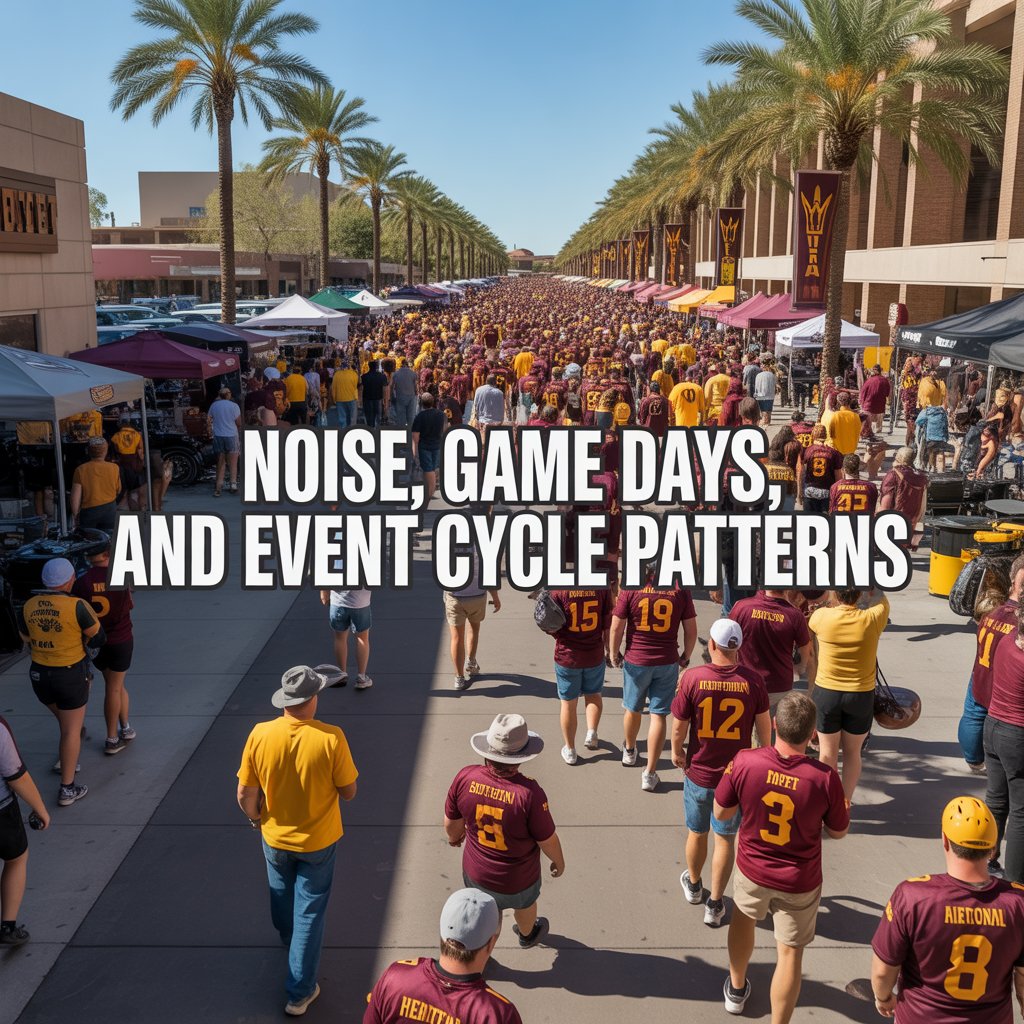
During fall and spring terms, student density amps up everything: foot traffic, bar chatter, distant bass from venues. Streets near Mill hum from afternoon through midnight, especially Thursday-Saturday. Game weekends layer on roars from Sun Devil Stadium — cheers that carry a mile or more on clear nights.
Summer brings the exhale. With 70% of students gone, Mill quiets to local levels — patios still fill, but without the constant scooter swarms or late-night crowds. It’s the season when even downtown feels residential.
This isn’t chaos; it’s clockwork. Buyers who time purchases for early summer often negotiate better, as sellers crave the post-term calm.
Game Day Patterns: Stadium to Street
ASU football (August-December) drives Tempe’s loudest days — typically six home games, plus playoffs. Basketball and baseball add lighter pulses through spring.
- Stadium noise radiates north-south along Mill and Priest Drives, peaking at kickoff, halftime, and final scores. It’s crowd roar, not music — thrilling if you’re tailgating, grating if you’re trying to sleep in.
- Pre- and post-game waves hit Mill hardest. Arrivals build from noon; streets pulse until 2 a.m. Parking overflow spills into neighborhoods, adding car doors and laughter.
The stadium’s modern design directs sound upward, but wind and proximity matter. Homes south of Rio Salado or buffered by Papago Buttes feel less. North of University Drive? You’re in the echo.
Non-football game days (soccer, softball) are gentler — more cheers, less chaos. Still, Varsity Tavern and similar spots crank volume for screens and crowds.
Mill Avenue: Nightlife’s Reliable Pulse
Mill is Tempe’s noise epicenter — bars, clubs, live music venues like Shady Park drawing 20-somethings through faculty. Expect:
- Peak volume: Thursday-Saturday, 10 p.m.-2 a.m. Bass, laughter, music spilling onto sidewalks. Newer spots like Culinary Dropout add rooftop chatter.
- Legal pushback: Ongoing tensions with nearby condos (Mirabella) and hotels led to decibel caps (97 dB max) and earlier curfews for some venues. Live music now often ends by 11 p.m., muting the all-night vibe.
- Weekend evolution: Less dive-bar grit, more upscale dining — but crowds persist, especially post-mask era surges.
Evenings near Mill feel alive, not oppressive, if you’re a block off. Street-facing units? Windows-closed nights year-round.
Event Cycles: Festivals and Street Closures
Tempe layers seasonal events onto the academic base:
- Ironman Arizona (November): Mill closes for spectator cheers — positive noise, but traffic snarls.
- Second Sundays on Mill (monthly): Outdoor markets bring families, music, vendors — lively days, calm nights.
- Music festivals, holiday lights: Town Lake hosts Ironman finishes and holiday events, echoing along paths but fading by 10 p.m.
City ordinances now curb large parties — noise complaints trigger quick responses, especially residential areas. Construction (streetcar expansions) adds daytime rumble, but rarely past 7 p.m.
Summer dips event volume, letting neighborhoods breathe.
Noise by Pocket: What You’ll Hear
Mill fights noise with mitigation (venue pyramids, codes), but proximity is reality. South pockets insulate naturally.
Common Concerns and Real Talk
I hear the fears: “Will it ruin sleep?” “Game days every weekend?” Truthfully, no — six big ones, plus lighter events. Most noise is “happy loud” — cheers, not fights. But bass travels, shaking windows blocks away.
New high-rises (Mirabella) highlight mismatches: retirees near bars complain, but chose the spot. Test nights yourself — drive or walk during peaks.
White noise machines, quality windows, and floor choice help. Many love the pulse; it feels safe, vibrant.
Lifestyle Fit Over Tolerance
Noise patterns reward self-awareness. Thrill-seekers pick Mill. Families lean south. Hybrid types (Papago) get lake views minus chaos.
Long-term, noise-resilient areas hold value — demand stays high near action, steady in quiet pockets.
If you’re weighing these cycles against your daily calm, let’s map it to streets you’ll love — without surprises.
If you’re thinking about making a move in Tempe or anywhere in the Phoenix metro, you don’t have to figure it out alone. Reach out, and we’ll navigate the sounds, the peaks, and the quiet together — so your home feels like sanctuary, not soundtrack.
Get the full Phoenix Market Insights → [Market Insights]


-

Preventing Roof Damage Before Arizona Monsoon Storms
-

Why AC Tune-Ups Are Critical for Phoenix Homes
-

What Homeowners Should Inspect Before Phoenix Summer Heat Arrives