


Tempe Lifestyle Guide → [Tempe Lifestyle Guide] & Tempe Real Estate Guide→ [Tempe Real Estate Guide]
Written by: Renee Burke
There’s a rhythm to life in Tempe that longtime locals recognize immediately. It’s that easy balance between urban energy and everyday convenience — the kind that makes errands, commutes, or even weekend getaways feel delightfully manageable. A big part of that balance comes down to something many homebuyers overlook until they’re living here: freeway access.
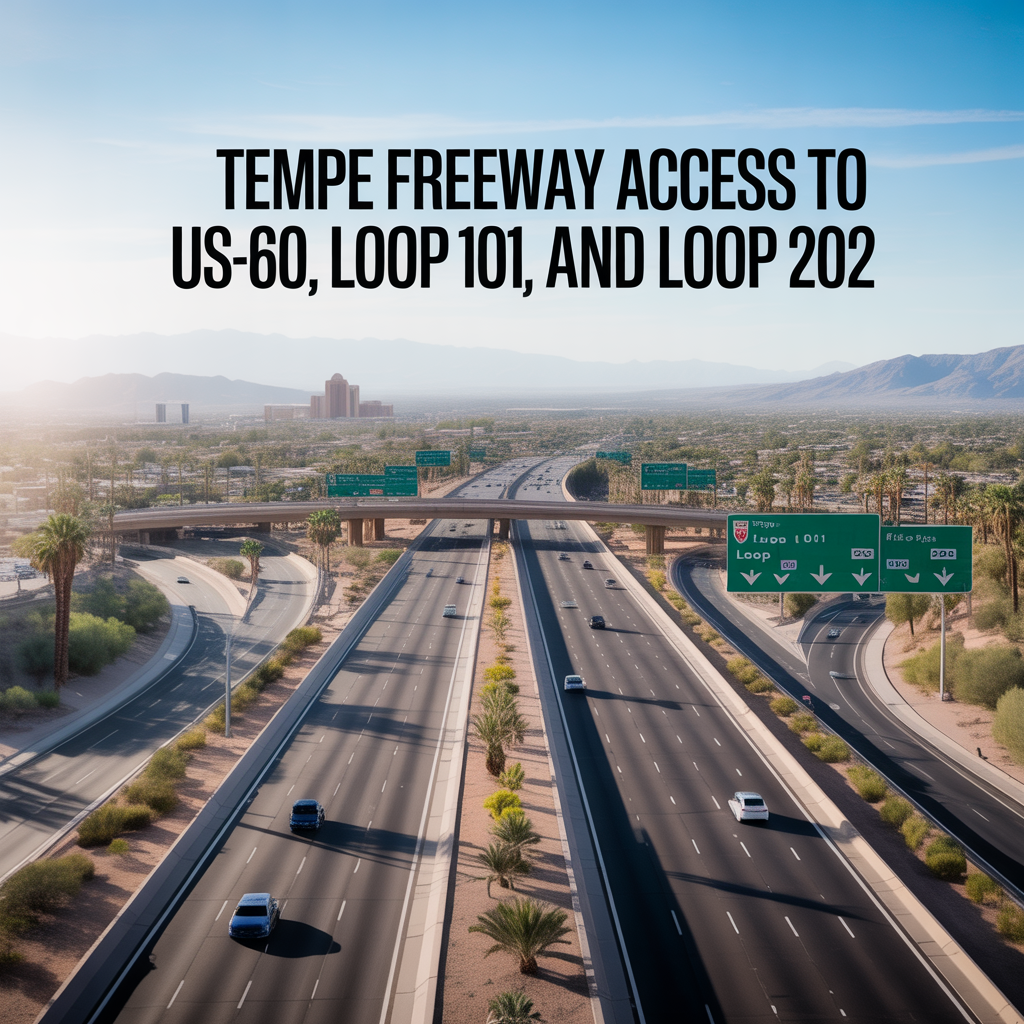
Tempe’s position between the US-60, Loop 101, and Loop 202 isn’t just about transportation — it’s part of what makes the city so livable, connected, and adaptable to nearly any lifestyle.
How Tempe Sits at the Heart of the Valley
Tempe may be compact compared to neighboring cities, but its connectivity is unmatched. Bordered by Scottsdale and Mesa to the east, and Phoenix to the west, it’s one of the few places in the Valley where you can be anywhere — truly anywhere — in under 30 minutes.
The US-60 (Superstition Freeway) runs east-west along Tempe’s southern edge, providing direct routes into Mesa, Gilbert, and Apache Junction. Meanwhile, the Loop 101 (Price Freeway) marks the city’s eastern boundary, linking Tempe directly to Scottsdale to the north and Chandler to the south. Add the Loop 202 (Red Mountain Freeway), which hugs Tempe’s northern border, and you have a triangle of connectivity that makes daily life remarkably smooth.
This freeway trio is what allows Tempe residents to access major employers, top universities, the airport, and recreation areas — all without the stress of long, unpredictable congestion. It’s one of those underappreciated local advantages that truly shows its value once you’ve lived here for a while.
Commuting Made Easy: Proximity to Everything
One of the defining appeals of Tempe is just how central it really is. For professionals who split their time between offices in East Valley cities or central Phoenix, having access to the US-60, 101, and 202 means travel times are both manageable and consistent.
- To Downtown Phoenix: Roughly 15–20 minutes via the 202 West
- To Sky Harbor Airport: About 10 minutes, often less depending on your route
- To Scottsdale: Around 15 minutes north on the 101
- To Chandler or Gilbert: 20 minutes south on the 101 or east via the 60
It’s not just about mileage, but momentum. The flow of these freeways — especially with the improvements made over the past decade — means Tempe residents can plan their days around opportunity, not traffic.
For those who work remotely or flex their schedules, this access adds a kind of freedom that’s hard to measure but easy to feel. Want to meet a client in downtown Phoenix in the morning, then catch a sunset jog around Kiwanis Park in the evening? Living near these corridors makes that simple.
Neighborhood Character and Lifestyle along the Freeways
Every stretch of Tempe feels a bit different, and much of that character reflects its proximity to the freeways. That doesn’t mean “busy” — rather, it often means “convenient.” Here’s how those differences play out across key neighborhoods:
- South Tempe (Near US-60): Known for mature neighborhoods, shaded streets, and quiet suburban comfort. Many homes here have been lovingly updated over the years, making them perfect for buyers who want established charm with modern touches.
- East Tempe (Near Loop 101): Offers newer developments and easy access to Chandler and Gilbert tech corridors. Perfect for those who value quick commutes to major employers while staying close to Tempe Town Lake and the city’s culture.
- North Tempe (Near Loop 202): A dynamic area that blends student life, lakefront living, and walkable amenities. Proximity to ASU, Mill Avenue, and Sky Harbor gives it an unmistakably urban feel — one that keeps evolving with new restaurants, bike lanes, and mixed-use projects.
Each corridor shapes not only commute times but also daily rhythm and neighborhood energy. That’s something you begin to notice only after spending years helping families and investors find their right fit here — you learn that “five minutes from the 101” means something very different in South Tempe than in North.
Addressing Common Buyer Concerns
Buyers often ask if living near a major freeway means dealing with constant noise or heavy traffic. That’s an understandable question — and a wise one to ask early.
In much of Tempe, freeway proximity and livability coexist beautifully. Builders and city planners have paid careful attention to sound barriers, natural landscaping, and zoning distances. In several neighborhoods, such as Warner Ranch or The Lakes, you can be only minutes from freeway access and still hear nothing but the soft hum of sprinklers or birds in the morning.
For homes closest to the freeway corridors, concrete walls, elevation shifts, and mature landscaping do a remarkable job of dampening sound while keeping that unbeatable location advantage.
On the flip side, homes farther from the freeways may feel quieter but lose that quick regional access. That’s why understanding your lifestyle priorities — commute, recreation, work-from-home flexibility — matters as much as square footage or finishes.
The Market Perspective
Accessibility plays a measurable role in property value stability and resale potential within Tempe. Homes with convenient freeway access — especially near the 101 and 202 — tend to maintain stronger long-term demand because of their reach to job centers and universities.
Tempe’s housing market is also shaped by a mix of short-term residents (students and early-career professionals) and long-term homeowners. The constant flow of people who prioritize easy commuting contributes to healthy housing turnover and steady appreciation.
For investors, that’s meaningful. Rental demand remains strong near each of these freeway corridors precisely because of proximity to employment hubs like ASU Research Park, Discovery Business Campus, and Sky Harbor.
For homeowners, it means one important thing: your home’s location continues to matter in ways that go beyond the ZIP code. It’s about connection — to opportunity, movement, and quality of life.
Lifestyle Beyond the Commute
It’s easy to think of freeway access as purely functional, but in Tempe, it often enhances lifestyle. Those connecting routes open the door to the entire Phoenix metro: a quick trip to hike the Superstitions, explore Old Town Scottsdale, or catch a Diamondbacks game downtown.
For families, they mean reaching top charter schools or evening activities in neighboring cities without it feeling like a trek. And for retirees or snowbirds? It means exploring without complication — whether that’s visiting family across town or heading toward East Mesa for a round of golf.
Good access also means options. Residents can enjoy the peacefulness of suburban enclaves while still being part of the Valley’s cultural heartbeat. That blend of convenience and flexibility is what keeps so many people in Tempe long-term — even as work, family, and lifestyle evolve.
A Final Thought
If you’ve lived in the Phoenix area for any length of time, you know that convenience isn’t just about cutting minutes off your commute — it’s about quality of life. Tempe’s freeway access quietly supports that quality every day, offering not just routes, but reassurance.
A home here isn’t only a place to live; it’s a launch point — to jobs, schools, family, friends, and the places that make the Valley of the Sun what it is.
Your Next Step
If you’re thinking about making a move in Tempe — or anywhere in the East Valley — you don’t have to figure it out alone. I’ve helped countless buyers and sellers navigate not only the neighborhoods and listings, but the nuances that truly define daily life here.
Whether you’re weighing proximity to freeways, comparing north versus south Tempe, or simply exploring what “convenience” really means for your lifestyle — I’d be happy to guide you through it all.
Reach out anytime. Let’s find a home that fits not just your needs, but your rhythm.
Get the full Phoenix Market Insights → [Market Insights]


-
Cost of Living in Rhode Island: Housing, Taxes, Utilities, and Everyday Expenses
-

What If My Commute Becomes Worse Than Expected?
-
How Aging Home Systems Affect Property Value