


Tempe Lifestyle Guide → [Tempe Lifestyle Guide] & Tempe Real Estate Guide→ [Tempe Real Estate Guide]
Written by: Renee Burke
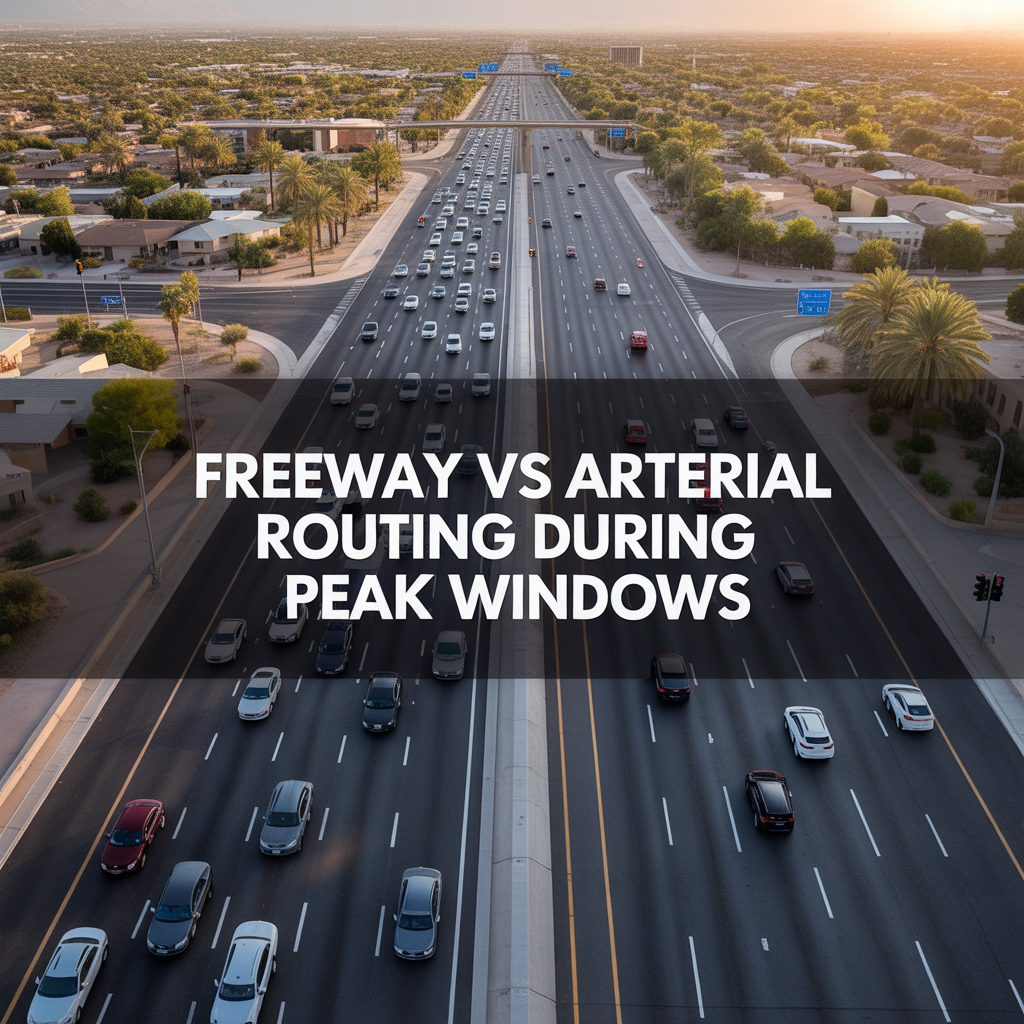
When you live in Tempe and your life involves regular trips to Sky Harbor, downtown Phoenix, or other parts of the Valley, the question isn’t just “how far is it?”—it’s “should I take the freeway, or stay on surface streets?” And during peak traffic windows, that choice can make or break your morning.
Let’s walk through how freeways and arterials really behave in Tempe during rush hour, and how different pockets of the city experience those patterns.
Understanding Phoenix Rush Windows
Phoenix tends to follow a fairly consistent rush pattern:
- Morning peaks typically fall between 6–9 a.m., with the busiest stretch around 7:30–8:30 a.m.
- Evenings usually back up between 3–6 p.m., with 4–5 p.m. standing out as the tightest window.
Layer onto that school dismissal times and the Valley’s heat (which nudges many workers toward earlier shifts), and you end up with a lot of people trying to move at the same times in the same places.
The key to choosing freeway vs. arterial in Tempe is understanding where those pressure points form—and how each Tempe pocket connects into them.
How Tempe’s Freeways Really Behave in Rush Hour
Tempe is wrapped in freeways: the 101 (Price) to the east, US‑60 cutting across the middle, and Loop 202 (Red Mountain) and I‑10 tying into Sky Harbor and downtown. Each has its own personality at peak times.
- I‑10 near the Broadway curve
This is one of the state’s heaviest-traveled segments, carrying commuters from the East Valley toward Phoenix and Sky Harbor. Merges from US‑60 and heavy truck traffic create a rolling bottleneck where a single stall can ripple for miles. - Loop 101 (Price Freeway) around US‑60 and 202
The stretch near Tempe—between US‑60 and Loop 202—is among the busiest in Arizona, with hundreds of thousands of vehicles daily. Traffic stacks up where 202 traffic meets those trying to transition to US‑60, especially in the afternoon. - US‑60 (Superstition Freeway)
Westbound in the morning and eastbound in the evening, US‑60 is a constant dance of merges and exits. ADOT has historically flagged sections between Mesa and Tempe as some of the most congested in the Valley, thanks in part to multiple major interchanges and high daily vehicle counts. - Loop 202 (Red Mountain) between Rural and Priest
This segment skirts Tempe Town Lake and feeds both Loop 101 and direct routes toward Sky Harbor. It routinely carries more than 180,000 cars a day and stacks up around event days at Tempe Beach Park or ASU games.
What this means in practice: during peak windows, freeways can be fastest when they’re flowing, but they are also where you’ll feel the biggest impact of a crash, lane closure, or minor stall.
The Role of Arterials: Priest, Rural, Broadway, Baseline
Arterials—the big surface streets like Priest, Rural, McClintock, Broadway, Baseline, and Guadalupe—become your pressure-release valve when the freeways choke up.
A few Tempe corridors stand out:
- Priest Drive
Priest is one of the most reliable non-freeway routes between south/central Tempe and the airport, running north from areas like Warner and Baseline straight toward Sky Harbor. You’ll hit lights, yes—but you skip the worst of the Broadway curve and I‑10 merges. - Rural Road
Rural threads through ASU and connects to Loop 202. It moves well off-peak but can slow significantly near campus transitions and events, especially between Apache and Rio Salado. - Broadway Road & Baseline Road
These east–west arterials offer alternate paths parallel to US‑60. They’re signal-heavy, but in a serious freeway backup, they can give you a predictable timeline instead of stop‑and‑go unpredictability.
Realistically, arterials are rarely “fast” in a pure miles‑per‑hour sense during peak windows, but they are often steady, and that steadiness can matter more when you have a flight to catch or a meeting to make.
North Tempe: When Freeway Shortcuts Win (and When They Don’t)
In north Tempe—around Tempe Town Lake, ASU main campus, and the neighborhoods near Rio Salado and University—Loop 202 is your immediate freeway spine.
- Freeway advantage:
In lighter traffic, hopping on 202 to reach Sky Harbor or downtown is usually the quickest route, often under 15 minutes to the airport. - Freeway risk:
During 4–5 p.m., the Rural–Priest stretch of 202 can slow dramatically, especially when events let out near Tempe Beach Park or Sun Devil Stadium. - Arterial alternative:
Priest Drive or Mill/Rural northbound gives you a consistent—if slower—backup route where you’re less likely to be trapped by a single freeway incident.
If you live in this pocket and often drive during peak windows, I typically tell clients: rely on 202 as your default, but always have Priest programmed as your Plan B.
South & Southwest Tempe: Predictability vs. Pure Speed
In south and southwest Tempe—around Warner, Elliot, and neighborhoods off Kyrene or Priest—the choice between freeway and arterial looks a little different.
- Freeway routes:
Many residents flow north via 101 to 202, or US‑60 to I‑10, depending on destination. These can be quite efficient just outside the sharpest rush window, but they’re sensitive to incidents at the 101/60 and 60/10 transitions. - Arterial routes:
From this area, using Priest Drive or Broadway toward the airport or central Phoenix often results in a slower top speed but a calmer, more predictable trip. This is especially appealing for families or anyone who simply prefers avoiding high‑speed merges.
My south Tempe clients who fly often often end up with a hybrid habit: freeways when leaving at, say, 5:15 a.m. or mid‑day, arterials when leaving between 7–8:30 a.m. or 4–5:30 p.m.
East Tempe & the 101/60 Pocket: Strategic Freeway Use
Along Tempe’s eastern edge—near the 101 corridor, Baseline, Southern, and the border with Mesa—freeways are both your greatest asset and your biggest variable.
- 101 + 60 combo:
This is a powerful corridor when moving outside peak windows, tying you quickly to downtown, the airport, or other East Valley cities. - Peak-window caution:
The segment where 101 meets 60 is one of the most heavily used freeway junctions in the Valley, and merges can balloon travel times in both morning and evening rush. - Arterial strategy:
East Tempe residents often use Southern, Broadway, or Baseline westbound to “skip” problem segments, then join I‑10 or 202 closer to Phoenix when traffic is more dispersed.
If you live here, freeways will likely form the backbone of your routine, but you’ll want to learn at least one east–west arterial you’re comfortable using as a bypass when the apps turn red.
When to Prefer Freeways vs. Arterials
Here’s a simple way to think about it during peak windows:
- Choose freeways when:
- You’re traveling a longer distance across the Valley.
- You can leave slightly before or after the absolute peak (for example, 6:30 a.m. instead of 7:45 a.m.).
- You’re comfortable with merges and willing to adjust on the fly if a crash pops up.
- Choose arterials when:
- Your origin and destination are both within Tempe or nearby cities.
- You’re driving squarely inside the 7:30–8:30 a.m. or 4–5 p.m. windows.
- You’d rather trade 5 extra minutes for consistent movement and lower stress.
Most seasoned Tempe drivers end up with both a “fastest if everything goes right” freeway route and a “solid no‑matter‑what” arterial route, and they flip between them depending on the day.
How This Ties Back to Where You Live
This is where lifestyle and real estate intersect.
If you:
- Fly often for work
- Have kids in sports or activities all over the East Valley
- Commute daily into central Phoenix or north Scottsdale
…then the difference between a home that feeds directly into a stable arterial like Priest, versus one that depends on a dicey merge like I‑10 at the Broadway curve, really does shape your day‑to‑day experience.
When I’m walking Tempe neighborhoods with clients, we’re not just talking about bedrooms and countertops. We’re talking about which routes they’ll actually use at 7:30 on a Tuesday, or how they’ll get to Sky Harbor at 4:30 on a Thursday without feeling wrung out before they even board.
A Warm Invitation to Talk It Through
If you’re looking at homes in Tempe—or already live here and are thinking about your next move—you don’t have to sort out all these routing nuances on your own.
We can sit down with your real schedules, your likely commute times, your airport habits, and then overlay that onto specific Tempe pockets and routes. My goal is always to help you choose a home that fits not just your budget, but the way your life actually moves through the Valley.
If you’re thinking about making a move in Phoenix, you don’t have to figure it out alone. Reach out with your questions, your “what ifs,” and even your worries about traffic and drive times. I’m here as a steady, long‑term advisor—someone you can lean on as you make smart, confident decisions about where to call home.
Get the full Phoenix Market Insights → [Market Insights]


-

Preventing Irrigation Leaks That Waste Water in Desert Landscapes
-

Signs of Hidden Plumbing Leaks in Phoenix Houses
-

How Long Water Heaters Last in Arizona Homes