


This is part of the RI Market Insights Hub → [RI Market Insights Hub] also research RI Home Buying Process→ [RI Home Buying Process] and RI Home Selling Process → [RI Home Selling Process]
Written by: Hilary Marshall
If you’re trying to decide whether to buy, sell, or hold in Rhode Island, the most important thing to know is that the market has shifted from explosive growth to slower, steadier appreciation. We’re not in a crash, and we’re not in a 2020–2021‑style bubble; we’re in a phase where home values are expected to rise just enough to keep pace with, but not outrun, the larger economic picture.
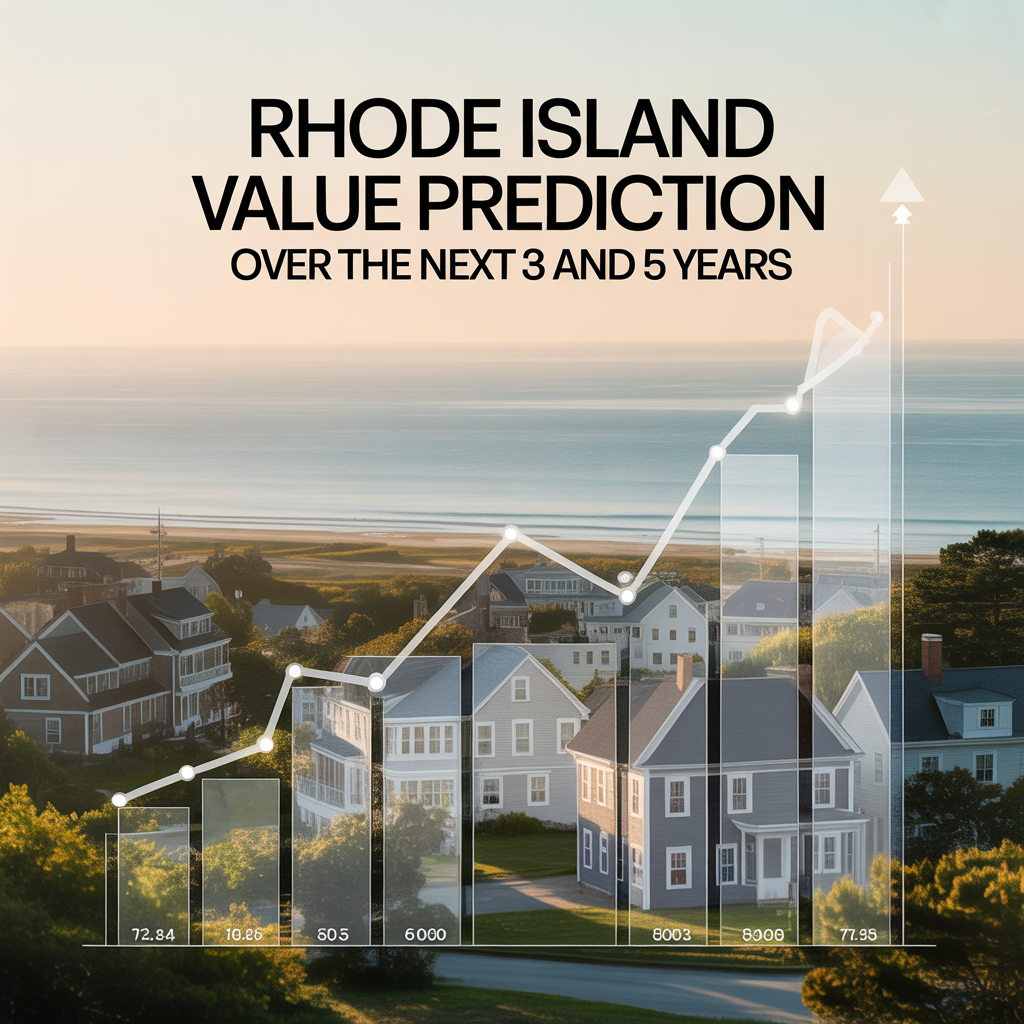
Across the state, most recent data and forecasts paint a consistent picture: prices are likely to grow at a moderate 2–4 percent per year over the next few years, with the bulk of the action happening in the middle‑price bands, not the very top or the very bottom. The long‑term outlook—3 to 5 years out—does not look like a slide back to 2019 levels, but rather a continuation of elevated, but calmer, growth.
What the next 1–2 years are likely to look like
In 2026, most national and local models are converging on a modest‑up view. The consensus is that home prices in Rhode Island will rise somewhere around 2–4 percent, with some models clustering near 3.5 percent as a realistic annual growth rate. That’s a far cry from the double‑digit gains of 2020–2021, but it’s still positive growth.
At the margins, that translates into a median single‑family price that could move from the current 499,000–525,000 range toward roughly 510,000–540,000 by the end of 2027, assuming the 3–4 percent band holds. The average price will likely climb a bit faster, pushed up by the continued activity at the higher end, especially in coastal and luxury‑leaning segments.
On the ground, buyers will see:
- More inventory than in 2021, but still below “balanced” levels, with months of supply closer to 2 than 5 or 6.
- Days on market in the low‑ to mid‑thirties instead of the high‑teens, meaning the market breathes a bit more, but it’s still not a buyer‑dominated free‑for‑all.
- More room for negotiation, especially in upper‑price bands, while the 300,000–500,000 bracket remains competitive.
For sellers, the 1–2 year window looks like a continuation of the current pattern: prices that are still appreciating, but not at a breakneck pace. The 2–4 percent growth band is favorable for equity‑building, but it doesn’t justify aggressive overpricing.
What the 3‑year (2026–2028) picture looks like
Extending that 2–4 percent annual growth forward suggests a calibrated climb rather than a spike. If Rhode Island’s single‑family median sits near 500,000 in 2025–2026, three years of 3 percent‑style appreciation would put it in the low‑550,000s by 2028.
Within that window, different segments will behave differently:
- Mid‑range, entry‑level, and move‑up homes in desirable towns (Warwick, East Greenwich, parts of the Providence perimeter, and certain coastal pockets) will likely see the most consistent gains, because demand is steady and inventory is tight.
- Luxury and upper‑price homes will grow more slowly, with appreciation closer to 1–3 percent per year, because those buyers are more rate‑sensitive and more picky about inventory, condition, and long‑term costs.
- Inland and less‑walkable towns will likely see the lightest appreciation, and some may flatten or even dip slightly if new‑construction supply increases more than demand in those pockets.
The 3‑year outlook is not about a “correction” so much as a normalization. The market is still supply‑constrained, and that alone tends to keep prices supported even when demand softens a bit.
What the 5‑year horizon (2026–2031) could look like
Looking further out, many forecasters see the 2–4 percent growth band persisting, though the exact numbers vary by model. If that holds, Rhode Island’s median single‑family price could move from roughly 500,000 today into the 580,000–620,000 range by 2030–2031, again assuming the 3 percent‑style annual growth is sustained.
At the 5‑year horizon, the story is less about rate‑driven spikes and more about supply, interest‑rate environment, and local demand fundamentals. If new construction accelerates meaningfully, prices could rise a bit more slowly, but they’re still unlikely to fall dramatically because Rhode Island is small, desirable, and already short on housing. If new‑home production lags, the 2–4 percent band would likely hold, and the state would remain a “seller‑friendly” environment, just not in the frantic way it was in 2020–2021.
For buyers thinking about a 30‑year mortgage, the 5‑year view is crucial: paying 500,000 today and seeing the home’s value at 600,000–620,000 in five years is a different proposition than paying 700,000 and hoping it jumps to 900,000. The 2–4 percent band favors those who can tolerate slower, but steady, equity growth.
How coastal vs inland might diverge over the next 3–5 years
The 2025 and 2026 forecasts for coastal vs inland Rhode Island point to a subtle but real split.
- Coastal markets (Newport, Middletown, Narragansett, parts of South Kingstown, Washington County)
Coastal homes are likely to see slower appreciation than the statewide average, because of higher‑end prices, more rate‑sensitive buyers, and tighter inventory. In the 3–5 year horizon, we’re more likely to see 1–3 percent annual growth in those pockets, especially above 650,000 dollars. - Inland and Providence‑adjacent markets (Warwick, East Providence, parts of North Kingstown, Smithfield, and Providence suburbs)
These areas, where inventory is still limited but prices are a bit lower than the coast, are more likely to see closer to the 3–4 percent band. Demand from buyers priced out of Massachusetts and Connecticut, combined with strong local employment, keeps the pressure on the mid‑range more than at the luxury end.
The coastal‑inland split is not about one “winning” and the other “losing”; it’s about where the growth rate is. Coastal values will stay high, but the engine is slower. Inland values will rise at a more brisk pace, but from a lower starting point.
How I help clients navigate this range of uncertainty
Forecast numbers are useful, but they’re not guarantees. As someone who’s been through several cycles, I treat the 2–4 percent band as a planning baseline, not a promise.
For buyers, I emphasize:
- Building a payment cushion so you’re not relying on rapid appreciation to justify the price you pay.
- Focusing on where you’ll actually live, not just on the resale math.
- Using the 3–5 year window as a reason to buy for lifestyle and long‑term fit, not as a speculation play.
For sellers, I’m just as clear:
- If you’re selling in 2026–2028, you’re in a market that’s still appreciating, but not at a pace that justifies extreme overpricing.
- The 3–5 year horizon is more about steady, modest gains than quick windfalls, so the goal is to sell at a price that reflects current comps and your home’s condition, not its “potential” under a bubble‑style forecast.
The bottom line
Over the next 3 years, Rhode Island home values are expected to rise at a modest 2–4 percent per year, with the median single‑family price likely moving into the low‑550,000s by 2028. Over the next 5 years, that band could push the median into the 580,000–620,000 range, assuming the same growth pattern holds.
In that environment, the market is unlikely to crash, but it’s also unlikely to rocket. The real story is normalization: prices settle at a higher level than 2019, but the growth is slower, more predictable, and more tied to supply, demand, and interest rates than to speculation.
If you’re trying to decide whether to buy, sell, or wait, the most practical takeaway is this: waiting for a crash is risky, and assuming prices will keep doubling is unrealistic. Planning for steady, low‑single‑digit growth over the next 3–5 years is how you position yourself for a Rhode Island market that’s still strong, but no longer on fire.
Get the full Rhode Island Market Insights → [Market Insights]

Understanding Market Cycles in Rhode Island Real Estate
This is part of the RI Market Insights Hub → [RI Market Insights Hub] also research RI Home Buying Process→ [RI Home Buying Process] and RI Home Selling Process → [RI Home Selling Process] Written by: Hilary Marshall I’ve been working with buyers and sellers across Rhode Island for over 20 years now, and one thing I’ve learned…


Is There Any Indication of a Coming Market Crash in Rhode Island
This is part of the RI Market Insights Hub → [RI Market Insights Hub] also research RI Home Buying Process→ [RI Home Buying Process] and RI Home Selling Process → [RI Home Selling Process] Written by: Hilary Marshall Every few weeks, I get asked the same question—sometimes quietly, sometimes nervously—“Hilary, do you think the Rhode Island housing market…

How Rhode Island Home Values Have Changed Over the Last 10 Years
This is part of the RI Market Insights Hub → [RI Market Insights Hub] also research RI Home Buying Process→ [RI Home Buying Process] and RI Home Selling Process → [RI Home Selling Process] Written by: Hilary Marshall If you bought a home in Rhode Island around 2016 and haven’t tracked the numbers closely, the most important thing…