


This is part of Homeownership 101→ [Homeownership 101]
Written by: Chad Cabalka
Homeownership often comes with a quiet calculation running in the background: how long can you make things last before they truly need replacing? On the surface, putting off a major expense feels like the frugal choice. You get to save money now, stretch another year or two out of what you already have, and avoid the disruption of repair work. But over time, that line of thinking can backfire. When key parts of a home—such as a roof, water heater, HVAC system, or major appliance—start nearing the end of their service life, waiting too long to replace them can end up increasing costs in ways most people do not immediately see.
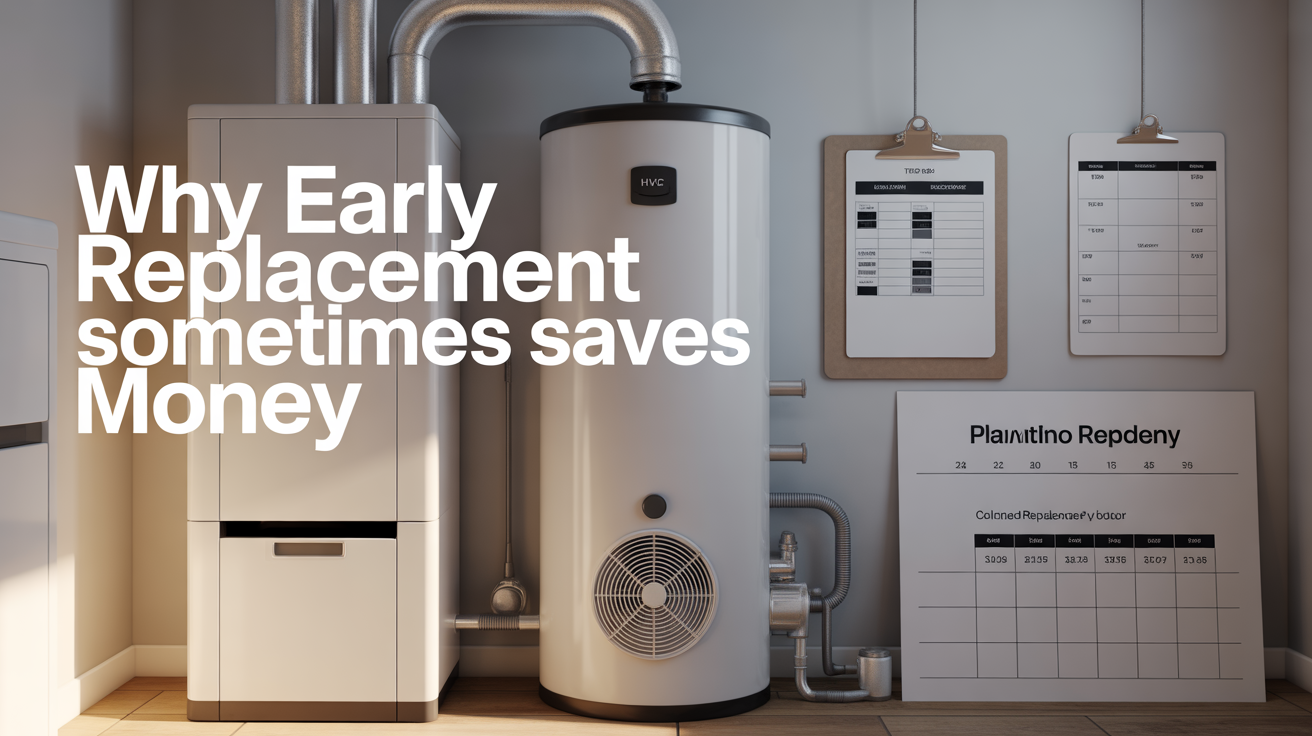
Early replacement is not about spending money prematurely. It’s about understanding how performance, efficiency, and maintenance costs interact as a system ages. A furnace that’s ten years old might still run, but if it breaks down twice a winter or uses far more energy than its newer counterparts, it quietly drains money in the background. The same logic applies to roofs that begin leaking unpredictably or windows that no longer seal properly. The dollars may not always show up in one big repair bill; they often appear gradually in energy costs, hidden damage, or the inconvenience of poorly timed breakdowns.
Thinking about replacement early can feel uncomfortable because it challenges a basic instinct to “get the full value” out of something before letting it go. Yet, understanding the tradeoff between value and risk can help a homeowner make stronger long-term decisions. Replacing at the right time—before failure forces your hand—can protect your home’s value, reduce stress, and often cost less in the end. Early replacement is not about premature spending; it’s about managing wear wisely.
How This Shows Up in Real Homes
This issue becomes obvious in situations most homeowners recognize. A furnace begins making unusual noises or needs service multiple times within a few seasons. The technician can patch it, but the repairs grow more frequent, and the efficiency drops. Energy bills inch upward, and the house takes longer to heat. While the unit is technically “still working,” its reliability is dwindling. Waiting until it fails completely often means paying for an emergency replacement at the worst possible moment, usually in the heart of winter when contractors are busiest and options are limited.
The same pattern shows up with roofs. A few missing shingles after a windstorm may not seem urgent, especially if no attic leaks appear right away. But small defects allow moisture to seep into the structure where it can cause hidden damage. Over several seasons, this slow infiltration can destroy insulation, stain ceilings, and rot unseen wood sheathing. By the time those symptoms surface, the repair is no longer simple—and costs climb dramatically. An earlier roof replacement, though more expensive up front, may have saved thousands in repairs and interior restoration later.
Appliances tell similar stories. A dishwasher that leaves residue on dishes or a refrigerator that struggles to maintain temperature might seem merely inconvenient. Over time, though, they use more water and energy, adding to utility bills and contributing to daily frustration. In each of these examples, the problem is subtle but real: the household keeps spending, just in smaller, less visible ways. Replacing these items before total failure is rarely about luxury—it’s about restoring reliability and controlling long-term costs.
Common Misunderstandings Homeowners Have
Many homeowners assume that using something until it stops working is the most financially sensible approach. After all, why replace what still functions? This belief is understandable and, on the surface, seems practical. Yet, it overlooks the way maintenance costs, energy inefficiency, and secondary damage accumulate quietly. A roof, furnace, or appliance may still operate, but running inefficiently often costs more over the last few years of its life than replacing it slightly earlier would have.
Another common misunderstanding lies in how warranties and replacement parts intersect with age. People sometimes assume they can always fix older systems inexpensively, but manufacturers discontinue components, technologies evolve, and certain repairs become less reliable over time. Paying for one more repair on a 15-year-old water heater may feel thrifty in the moment, but that repair might extend its life only briefly. If a homeowner must then replace the whole system six months later, they have effectively paid twice for a single problem.
Timing also confuses people. Homeowners often expect clear warning signs before something fails completely. In reality, many systems decline silently. Water heaters can corrode internally, air conditioners can lose refrigerant efficiency, and small leaks can remain concealed until damage spreads. Because there is no dramatic failure event, it is tempting to keep postponing replacement. That delay, however, often turns into compounded costs when the problem eventually surfaces at an inconvenient time or involves preventable collateral damage.
Why These Assumptions Create Problems Over Time
The challenge with waiting too long lies in how small inefficiencies and risks accumulate. Equipment that operates below peak efficiency may use more power or fuel, quietly raising monthly costs for years. For instance, an aging furnace might burn more natural gas than a modern model with advanced heat exchangers. The monthly difference may seem minor—perhaps ten or twenty dollars—but multiplied by several winters, the total can easily exceed the cost difference between late and timely replacement. The same holds for older windows that leak warmth or cooling throughout the year.
Another long-term issue involves timing and availability. When a major component fails suddenly, the homeowner loses control over scheduling, pricing, and sometimes even product choice. Emergency replacements often mean paying a premium for expedited service or accepting a model that was not the first choice simply because it was available on short notice. A homeowner planning a replacement in advance, however, can gather bids, compare efficiency ratings, and schedule work during slower seasons, when contractors may offer lower rates.
The final consequence is harder to measure but deeply felt: stress. Managing a failure under pressure—such as a burst water heater or failing furnace during extreme weather—creates disruption beyond financial cost. It can lead to several days without key utilities, quick decisions made without full context, and damage control that overshadows other priorities. Over time, consistently reacting to problems late becomes more costly and exhausting than proactively scheduling upgrades on your own terms.
How Thoughtful Homeowners Handle This Differently
Experienced homeowners often think about replacement not as a single large expense, but as part of a broader plan for maintaining their home’s performance. They track the approximate lifespan of major systems—like roofing, HVAC equipment, and water heaters—and set aside savings gradually for their eventual replacement. This approach removes the element of surprise and allows replacement to occur on schedule, before wear turns into crisis. When costs are anticipated, decisions can be made calmly and deliberately, focusing on quality and long-term value rather than speed.
They also pay close attention to performance changes that may not seem urgent at first. Instead of waiting for complete failure, they note patterns such as rising energy bills, uneven heating or cooling, or unusual noises from equipment. These are signs that efficiency is declining, and addressing them early often makes replacement more economical. Being observant does not mean replacing everything at once—it means understanding when an old system begins costing more than it contributes.
Thoughtful homeowners also consider the hidden costs of inaction, not just the upfront price of replacement. They view upgrades to key systems as a way to stabilize expenses, reduce surprise, and protect the value of the home. A new roof or efficient furnace may not be exciting, but both protect the structure and reduce operating costs over time. By making replacements early, they turn potential emergencies into well-planned projects, preserving both their financial stability and peace of mind.
What to Keep in Mind Moving Forward
The goal is not to replace everything early, but to replace things wisely. Every major system in a home follows a predictable pattern of wear and decline. Stretching that lifespan can be sensible as long as the cost of doing so—through repairs, inefficiency, or risk—is genuinely lower than replacement. The moment those hidden costs start to outweigh the savings, postponing replacement stops being economical. Recognizing that tipping point takes observation and a willingness to plan ahead rather than react.
For most homeowners, the best long-term strategy involves balancing two ideas: value and reliability. Maximizing value means using your home’s systems to their full potential without letting them become a financial liability. Maintaining reliability means keeping the home functional and comfortable without interruption. Early replacement fits squarely at the intersection of those goals. It avoids the cumulative drain of inefficiency and the chaos of untimely breakdowns, ultimately saving money not by spending less, but by spending smarter.
Looking ahead, treating replacement as part of normal home stewardship—rather than a last resort—creates stability. When replacements happen by choice rather than by necessity, the homeowner retains control, avoids unnecessary stress, and often spends less over the life of the home. Seen through that lens, early replacement is not a matter of giving up on what still works—it is a disciplined way of protecting both your home and your financial wellbeing.
Get the full Denver Market Insights → [Market Insights]



Littleton’s Ken Caryl for Lockheed Relocations
This is part of Lockheed Martin Relocation → [Lockheed Martin Relocation Hub] & the larger Denver Relocation Hub → [Denver Relocation Hub] Written by: Chad Cabalka Ken Caryl is one of the best-kept “family first” relocation options for Lockheed Martin employees who want foothills scenery, strong neighborhood appeal, and a real suburban lifestyle that still feels connected…


Centennial & Parker for Lockheed Relocations
This is part of Lockheed Martin Relocation → [Lockheed Martin Relocation Hub] & the larger Denver Relocation Hub → [Denver Relocation Hub] Written by: Chad Cabalka Centennial and Parker are two of the smartest suburban choices for Lockheed Martin employees relocating with families because they give you a strong balance of commute flexibility, good neighborhood variety, and…

Highlands Ranch for Family-Friendly Lockheed Relocations
This is part of Lockheed Martin Relocation → [Lockheed Martin Relocation Hub] & the larger Denver Relocation Hub → [Denver Relocation Hub] Written by: Chad Cabalka Highlands Ranch is one of the strongest choices for Lockheed Martin employees relocating with families because it delivers exactly what most parents want after a big move: stable neighborhoods, strong community…