


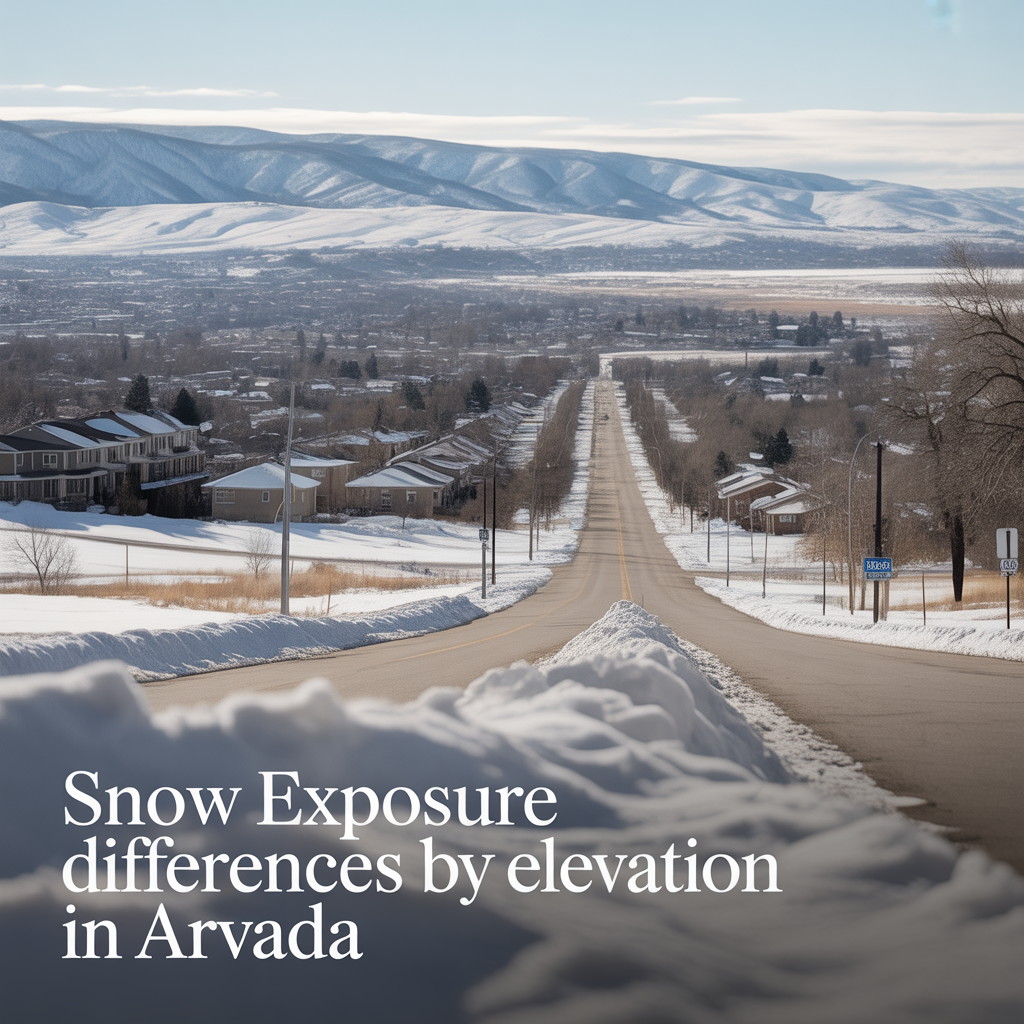
This is part of Arvada Lifestyle Hub → [Arvada Lifestyle Hub] & Arvada Real Estate Guide → [Arvada Real Estate Guide]
Written by: Chad Cabalka
If you’ve lived anywhere along the Front Range for long, you already know that snow in Denver isn’t just one thing. A storm can leave a foot of powder in one neighborhood and barely dust another. But in Arvada, that difference can be dramatic — sometimes amounting to several inches or even an entirely different experience of winter living.
Understanding how elevation affects snow exposure in Arvada isn’t just small talk for weather buffs. It has real implications for how you maintain your property, manage runoff, plan for landscaping, and even estimate long-term wear and tear on your home. Whether you’re buying, selling, or staying put, the nuances of Arvada’s microclimates are worth paying attention to.
The Landscape That Shapes Arvada’s Winter
Arvada sits on the northwestern edge of the Denver metro area, tucked between the city’s urban lowlands and the first roll of the foothills. It covers more than 30 square miles — from roughly 5,100 feet in elevation in east Arvada near Sheridan Boulevard to over 5,700 feet near the western neighborhoods bordering Highway 93 and Leyden Rock.
That 600-foot change might not sound like much, but here on the cusp of the Rockies, it’s enough to alter snow patterns significantly. The farther west you go — into communities like Candelas, Leyden Rock, and Whisper Creek — the closer you get to the mountains. That often means colder air, more frequent upslope snow events, and slightly longer melt times. Meanwhile, down in older neighborhoods like Olde Town, Lamar Heights, or the area near 64th and Sheridan, snow tends to fall lighter and melt faster under warmer urban air.
This elevation gradient doesn’t just affect how Arvada looks under a blanket of snow. It changes how homeowners experience winter day to day — from driveway care to how early spring arrives in the yard.
How Elevation Impacts Snowfall and Retention
Snowfall in Arvada tends to increase gradually with elevation. Data from personal weather stations and localized climate records often show a difference of 10–25% more accumulation on the city’s western edge compared to neighborhoods on the eastern plains side. The reason lies in temperature, moisture flow, and topography.
Temperature and Atmosphere
At higher elevations, air cools slightly — roughly 3.5°F for every 1,000 feet of rise. That’s just enough to influence whether precipitation falls as rain or snow on marginal days. When a late-fall storm brings mixed precipitation to downtown Denver, those few degrees of difference can mean a heavier, wetter snow in west Arvada while areas closer to Sheridan may only see flurries or rain.
Once the snow falls, cooler nighttime temperatures in west Arvada help it linger longer. Lawns and driveways can stay icy for several extra days, especially in shaded pockets or north-facing exposures.
Orographic and Upslope Effects
“Orographic lift” is the meteorological term for what happens when moist air is forced upward by rising terrain. As it lifts — even modestly, as it does from central Arvada toward the foothills — the air cools and condenses, turning vapor into snowfall.
During classic Front Range upslope storms, when moist air pushes westward from the plains into the mountains, that lift becomes especially pronounced. Neighborhoods perched at higher points, like those near Leyden or along Highway 72, often catch the brunt of those snow bands. In the same storm, east Arvada might record four inches while west Arvada shovels twelve.
That’s the unique Denver pattern: sharp snowfall contrasts within just a few miles.
The Urban Heat Factor
While elevation accounts for much of the difference, there’s another factor at play: the urban heat island effect. East Arvada and its neighboring cities — Wheat Ridge, Westminster, and Denver proper — generate slightly more heat through buildings, pavements, and traffic.
This residual warmth means that after a storm, these areas often melt out quickly, sometimes within 24 to 48 hours. In contrast, the newer subdivisions farther west, where open space and natural terrain dominate, lack that same heat retention. Snow lingers longer, and nighttime icing is more common.
It’s not unusual in February to drive west from Sheridan into Candelas and watch the landscape shift from bare grass to solid white in just a few minutes. To longtime residents, it’s a familiar boundary — the moment winter really begins.
What It Means for Home Maintenance
For homeowners, elevation-driven snowfall differences influence far more than curbside scenery. The day-to-day realities of snow management can vary widely depending on which part of Arvada you call home.
Driveways and Surfaces
If you live toward the western edge, plan to shovel more often and invest in durable ice melt that’s safe for concrete. Driveways facing north or northwest — especially in neighborhoods with hillside lots — may stay icy for days at a time. Even freshly poured driveways can show premature wear if salt-based deicers are used repeatedly in those conditions.
In lower-elevation or denser neighborhoods, the challenge is usually water runoff and refreezing. Snow that melts rapidly during daytime warmth can refreeze overnight, forming slick patches near downspouts or sidewalks. Homes built in east Arvada before the 1980s sometimes lack modern grading, so directing meltwater away from foundations can require strategic drain placement or minor landscaping adjustments.
Roof and Gutter Considerations
In elevation-diverse areas like Arvada, roof performance through the winter can vary even on the same street. Homes in slightly higher terrain often experience heavier roof loads and more ice dam formation. Modern gutter guards and heat cables are common upgrades in west-side neighborhoods, where melt-freeze cycles occur more often.
Conversely, in lower elevations where snow melts quickly, gutters are more prone to collecting early spring debris and runoff. Regular maintenance every March or April helps prevent overflow once spring snow bursts arrive.
Landscaping and Trees
The same west-to-east temperature gradient affects landscaping outcomes too. West Arvada experiences longer freeze cycles, which can delay lawn green-up but also protect certain plants from premature budding. East Arvada’s earlier thaws, however, can lead to fluctuating soil moisture that stresses trees — especially ornamental varieties like ash or linden.
If you’re planting or replacing trees, consider species that can tolerate both cold pockets and dry spells. For elevated properties, that means evergreens like spruce and pine tend to thrive; for lower elevations, deciduous trees such as honeylocusts or lindens can better adapt to faster freeze-thaw swings.
How Snow Exposure Affects Property Value and Lifestyle
It’s natural to wonder whether these micro-differences influence home values. The honest answer: not directly, but they shape perception and daily convenience.
In high-elevation neighborhoods like Leyden Rock or Candelas, buyers often expect a little more winter maintenance in exchange for mountain views, newer homes, and open vistas. In those markets, heavier snow tends to be accepted, even appreciated — it reinforces that “foothills feel.” These areas often attract buyers who enjoy winter recreation or prefer a quieter setting.
East Arvada, closer to Denver, appeals to those who value shorter commutes and quicker thaws. Less snow accumulation translates to easier daily routines and lower maintenance concerns for older driveways, sidewalks, and roofs. For many homeowners, especially retirees or frequent travelers, that predictability matters more than a postcard snow view.
So while elevation doesn’t directly set pricing, lifestyle implications tied to snow exposure do influence long-term satisfaction — and how homeowners describe the pros and cons to the next generation of buyers.
Insurance and Risk Perspective
There’s one more subtle way snow differences show up: in how insurance claims play out. Roof and gutter damage from heavy winter cycles is more common in high-elevation neighborhoods. Homeowners in those areas may see more frequent ice dams, flashing separation, or shingle wear due to extended snowpack or melting patterns. Checking coverage for winter-related wear can prevent unpleasant surprises during a claim.
Meanwhile, lower-elevation homes face more intermittent freeze-thaw stress on exterior paint, concrete, and downspouts. Those small fluctuations, repeated over many seasons, lead to different types of aging. Insurance doesn’t always list “snow exposure” as a factor, but experienced local agents — and contractors familiar with Arvada’s terrain — understand these patterns intuitively.
Preparing for Long-Term Living
For anyone planning to stay in their Arvada home for the long haul, adapting to elevation-driven snow exposure isn’t just about comfort. It’s long-term stewardship.
A few strategies serve homeowners well:
- Plan your maintenance schedule around your elevation. Western neighborhoods may need roof checks and ice mitigation earlier each season. Lower elevations can delay until late winter but pay closer attention to runoff management.
- Choose plants and materials suited to your snow pattern. Certain paver stones and sealants hold up better under frequent thawing, while others are ideal for prolonged snow cover.
- Monitor temperature and runoff near your foundation. Small slope changes matter in Arvada’s varied topography. Ensuring correct drainage prevents frost heave and water intrusion as snow melts unevenly across your yard.
Taking these small, location-specific steps adds up to greater stability and fewer midwinter repairs.
A Broader Pattern Across the Front Range
Arvada’s snow exposure pattern reflects a larger truth about living along the Front Range: microclimates matter more than many homeowners realize. From Golden to Castle Pines, the subtle shift between one elevation band and the next can mean notable differences in snow, ice, and even home maintenance frequency.
But what makes Arvada unique is how sharply those gradients appear within one city’s borders. It’s a transitional landscape — not quite plains, not quite foothills — where two climates meet. That meeting point gives Arvada much of its visual diversity and character, from leafless, snow-dusted ridgelines to sun-warmed lawns a few miles east.
For Denver-area residents considering a move within Arvada, understanding that landscape is as essential as comparing square footage or school ratings. Climate is a long-term companion; you feel it every winter morning, across decades of ownership.
The Bottom Line: Know Where You Live, and Plan Accordingly
Owning a home in Arvada means embracing variety. You can stand on Sheridan Boulevard and see clear pavement, then look west toward snow-laden roofs only a short drive away. That’s not inconsistency — it’s the natural fingerprint of a city built across changing elevation.
For homeowners, that geography is both an opportunity and a responsibility. With awareness, you can choose the kind of winter experience that fits your lifestyle: quick-melting streets and easy-yard maintenance in east Arvada, or mountain moods and cooler summers in the west.
Either way, understanding your elevation’s influence on snow is one of the most practical forms of local knowledge you can hold. It helps you care for your property wisely, anticipate challenges before they become headaches, and appreciate why your neighborhood looks and feels the way it does each winter.
A Personal Word from a Longtime Denver Neighbor
I’ve lived and worked through more than a few Arvada winters — from years where we barely shoveled twice to those when we ran out of deicer by January. The difference, year after year, always comes back to elevation, exposure, and preparation.
If you’re new to Arvada or thinking about moving within the area, take the time to understand how your specific street fits into that picture. A few feet of snow difference can change how a home lives through the season — and over time, how well it weathers the years.
If you ever want to talk through what these factors might mean for your property plans — whether it’s buying, remodeling, or simply maintaining wisely — reach out directly. No pitches, no pressure, just an informed conversation with someone who knows these slopes, streets, and snow patterns firsthand.
Because in Denver real estate, context is everything — and in Arvada, that starts with elevation. If you’re curious how snow patterns, elevation, or microclimate might affect your Arvada home’s value or upkeep, let’s talk it through. I’m always glad to share local insight and help you make sense of what these details mean for your specific property or plans.
Get the full Denver Market Insights → [Market Insights]


Littleton’s Ken Caryl for Lockheed Relocations
This is part of Lockheed Martin Relocation → [Lockheed Martin Relocation Hub] & the larger Denver Relocation Hub → [Denver Relocation Hub] Written by: Chad Cabalka Ken Caryl is one of the best-kept “family first” relocation options for Lockheed Martin employees who want foothills scenery, strong neighborhood appeal, and a real suburban lifestyle that still feels connected…

Centennial & Parker for Lockheed Relocations
This is part of Lockheed Martin Relocation → [Lockheed Martin Relocation Hub] & the larger Denver Relocation Hub → [Denver Relocation Hub] Written by: Chad Cabalka Centennial and Parker are two of the smartest suburban choices for Lockheed Martin employees relocating with families because they give you a strong balance of commute flexibility, good neighborhood variety, and…

Highlands Ranch for Family-Friendly Lockheed Relocations
This is part of Lockheed Martin Relocation → [Lockheed Martin Relocation Hub] & the larger Denver Relocation Hub → [Denver Relocation Hub] Written by: Chad Cabalka Highlands Ranch is one of the strongest choices for Lockheed Martin employees relocating with families because it delivers exactly what most parents want after a big move: stable neighborhoods, strong community…