


This is part of Centennial Lifestyle Guide → [Centennial Lifestyle Hub] & Centennial Real Estate Guide → [Centennial Real Estate Guide]
Written by: Chad Cabalka
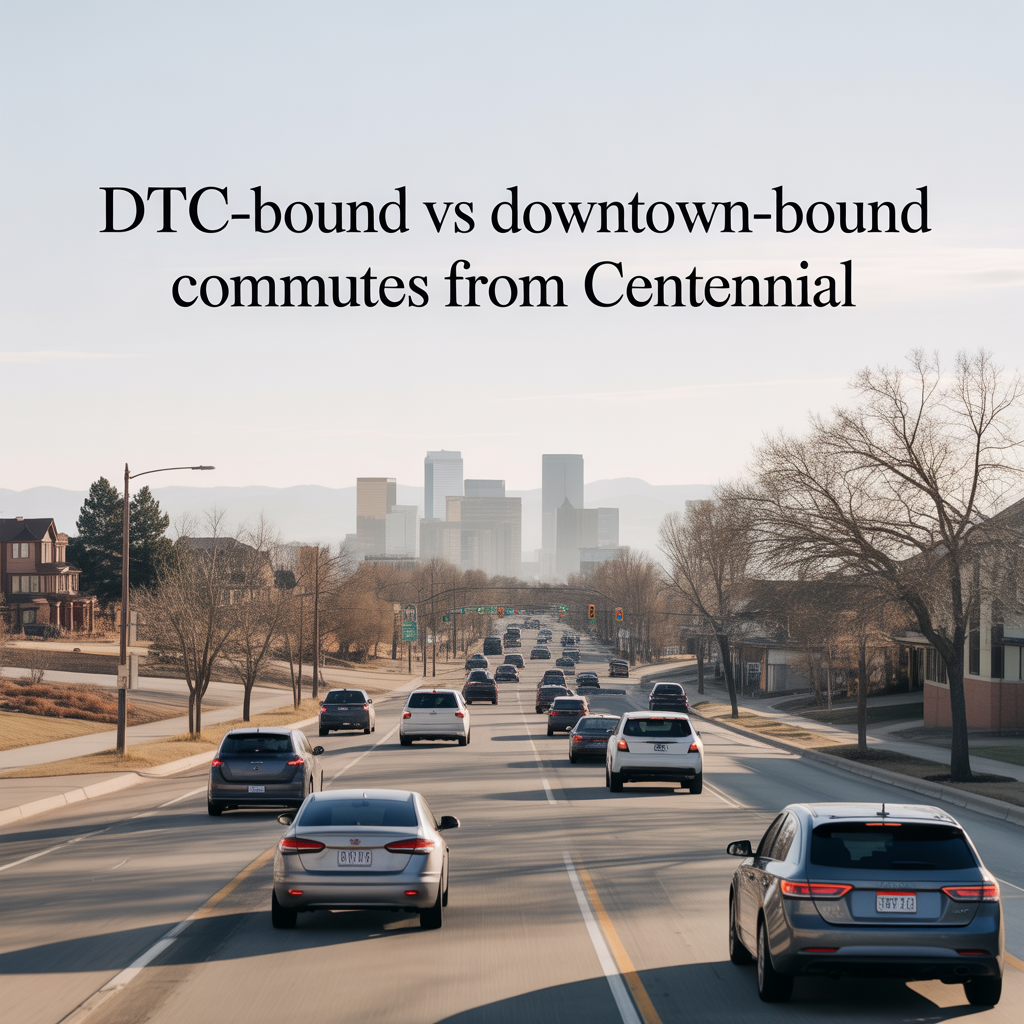
From Centennial, commuting to the Denver Tech Center and commuting to downtown feel like two very different lifestyles, even if the miles on a map don’t look that far apart. Over a few years, those patterns shape your stress level, your schedule, and the neighborhoods that make the most sense for you.
Big Picture: Distance vs Daily Reality
Centennial effectively borders the DTC, while downtown Denver is a full city‑center commute away. On paper, you might only see a difference of 10–12 miles, but in rush‑hour traffic and with I‑25 as your main artery, those extra miles tend to add 15–25 minutes each way on an average day. Over a year, that’s many hours added to your windshield time.
The other big difference is choice of route. DTC‑bound commuters can mix side streets, I‑25, E‑470, and even short hops to light rail; downtown‑bound commuters are much more dependent on long I‑25 or I‑225 stretches or a light‑rail ride that covers a bigger chunk of the city. That’s why two people both “working in Denver” can have radically different daily experiences depending on whether their office is at Belleview & Ulster or 17th & Broadway.
Typical DTC‑Bound Commute from Centennial
For most Centennial residents, a DTC commute is a short‑hop, south‑metro commute. In many neighborhoods you’re 10–20 minutes from the office outside of true peak rush, and 20–30 minutes during heavier windows. You can often choose between:
- A surface‑street route straight into the DTC grid (Arapahoe, Orchard, Dry Creek, County Line).
- A short jump onto I‑25 or E‑470, then cutting into the office parks.
- A quick drive or bike to a light‑rail stop like Dry Creek, County Line, or Orchard, then a short train ride into Belleview or Orchard stations.
That flexibility matters. If there’s a wreck on I‑25, you can usually drop back to the grid and still make it in a reasonable time. If you’re close to light rail, you can build in a train‑plus‑walk commute instead of fighting for freeway space every day. Over time, DTC‑bound commuters often describe their routine as “busy but manageable” — you still notice traffic, but it doesn’t dominate your day.
Because the DTC sits so close to Centennial’s north edge, many residents also find their workday anchors their local life: it’s easy to meet coworkers at nearby restaurants, run errands on the way home, or swing by kids’ schools and activities without major detours. That tight geographic loop is part of why Centennial is such a popular home base for south‑metro professionals.
Typical Downtown‑Bound Commute from Centennial
Downtown‑bound commuters are dealing with a different animal. You’re covering more distance and feeding into the densest part of the metro, with fewer realistic side‑street workarounds. A drive from Centennial into central Denver commonly lands in the 30–50 minute range depending on time of day, with bad days pushing past that. One source that tracks south‑metro commutes puts a similar distance at about 35–50 minutes to downtown in normal conditions.
You basically have three patterns to choose from:
- Drive the whole way via I‑25 or I‑225/I‑25, timing your departure to avoid the worst of the peaks.
- Park‑and‑ride to light rail, driving to a station like Dry Creek, County Line, Orchard, or Arapahoe at Village Center, then riding into downtown.
- Mix bus and rail, which is usually slower and more transfer‑heavy than the train‑plus‑car option.
The upside of the downtown commute is that once you’re there, you can often walk or use transit within the core. The downside is that your “bad days” feel more punishing: a single wreck, weather system, or downtown event can stack delays, and getting home late doesn’t leave much margin for kids’ activities, evening workouts, or south‑metro errands.
Downtown‑bound commuters from Centennial often talk about “training around the commute” — leaving very early, working remotely some days, or clustering long days to reduce the number of round trips. It’s doable, but it requires more deliberate planning than a DTC commute.
How Commute Direction Shapes Neighborhood Choice
Where your job sits on the map heavily influences which Centennial neighborhoods feel “livable” long‑term. For a DTC‑bound commuter, being north and west — closer to I‑25, Orchard, Dry Creek, County Line, and the light‑rail spine — usually feels like the sweet spot. Neighborhoods near Willow Creek, Foxridge, Walnut Hills, and around County Line Road can give you a sub‑20‑minute daily drive most days, plus easy access to DTC‑adjacent dining and services.
If you’re downtown‑bound, you may prioritize slightly different tradeoffs:
- Being closer to I‑25 or I‑225 to minimize your surface‑street leg.
- Having a straight‑shot route to a park‑and‑ride station where you actually like the parking, lighting, and walk from the platform.
- Picking a neighborhood where you can realistically leave the car at home some days — good trail connections, walkable errands, or a home office space to support hybrid schedules.
You may find that being a few minutes closer to the freeway or a train station matters more than being right next to a particular school or park, simply because the commute is such a large piece of your weekly bandwidth.
Long‑Term Lifestyle Differences
Over one month, the difference between a DTC‑bound and a downtown‑bound commute might just feel like “a bit more drive time.” Over five to ten years, it quietly shapes:
- How much you say yes to evening activities.
- Whether you still have the energy for workouts, social time, or kid logistics at the end of the day.
- How often you can realistically take advantage of local Centennial amenities — parks, trails, restaurants — on weeknights instead of just weekends.
DTC‑bound commuters often end up more embedded in the south‑metro rhythm: using local parks, trails, and restaurants throughout the week and building very tight home‑work‑school triangles. Downtown‑bound commuters sometimes end up with a split identity: part of their life is in the city center, part of it is in Centennial, and they have to be intentional about maintaining energy for both.
When I’m advising buyers in Centennial, I don’t just ask “Where do you work?” I ask, “Where will you most likely work for the next 5–10 years?” and “How do you handle traffic emotionally?” Someone who doesn’t mind a train ride with a podcast will experience a downtown job very differently from someone who hates feeling out of control in stop‑and‑go traffic.
If you’re weighing a move within Centennial or into the city and you’re not sure how a DTC‑bound versus downtown‑bound commute would actually feel over time, I’m happy to walk through it with you one‑on‑one. We can look at your real work schedule, your tolerance for traffic, and the neighborhoods that keep your daily life feeling sustainable — not just this year, but a decade from now.
Get the full Denver Market Insights → [Market Insights]


Littleton’s Ken Caryl for Lockheed Relocations
This is part of Lockheed Martin Relocation → [Lockheed Martin Relocation Hub] & the larger Denver Relocation Hub → [Denver Relocation Hub] Written by: Chad Cabalka Ken Caryl is one of the best-kept “family first” relocation options for Lockheed Martin employees who want foothills scenery, strong neighborhood appeal, and a real suburban lifestyle that still feels connected…

Centennial & Parker for Lockheed Relocations
This is part of Lockheed Martin Relocation → [Lockheed Martin Relocation Hub] & the larger Denver Relocation Hub → [Denver Relocation Hub] Written by: Chad Cabalka Centennial and Parker are two of the smartest suburban choices for Lockheed Martin employees relocating with families because they give you a strong balance of commute flexibility, good neighborhood variety, and…

Highlands Ranch for Family-Friendly Lockheed Relocations
This is part of Lockheed Martin Relocation → [Lockheed Martin Relocation Hub] & the larger Denver Relocation Hub → [Denver Relocation Hub] Written by: Chad Cabalka Highlands Ranch is one of the strongest choices for Lockheed Martin employees relocating with families because it delivers exactly what most parents want after a big move: stable neighborhoods, strong community…