


This is part of Centennial Lifestyle Guide → [Centennial Lifestyle Hub] & Centennial Real Estate Guide → [Centennial Real Estate Guide]
Written by: Chad Cabalka
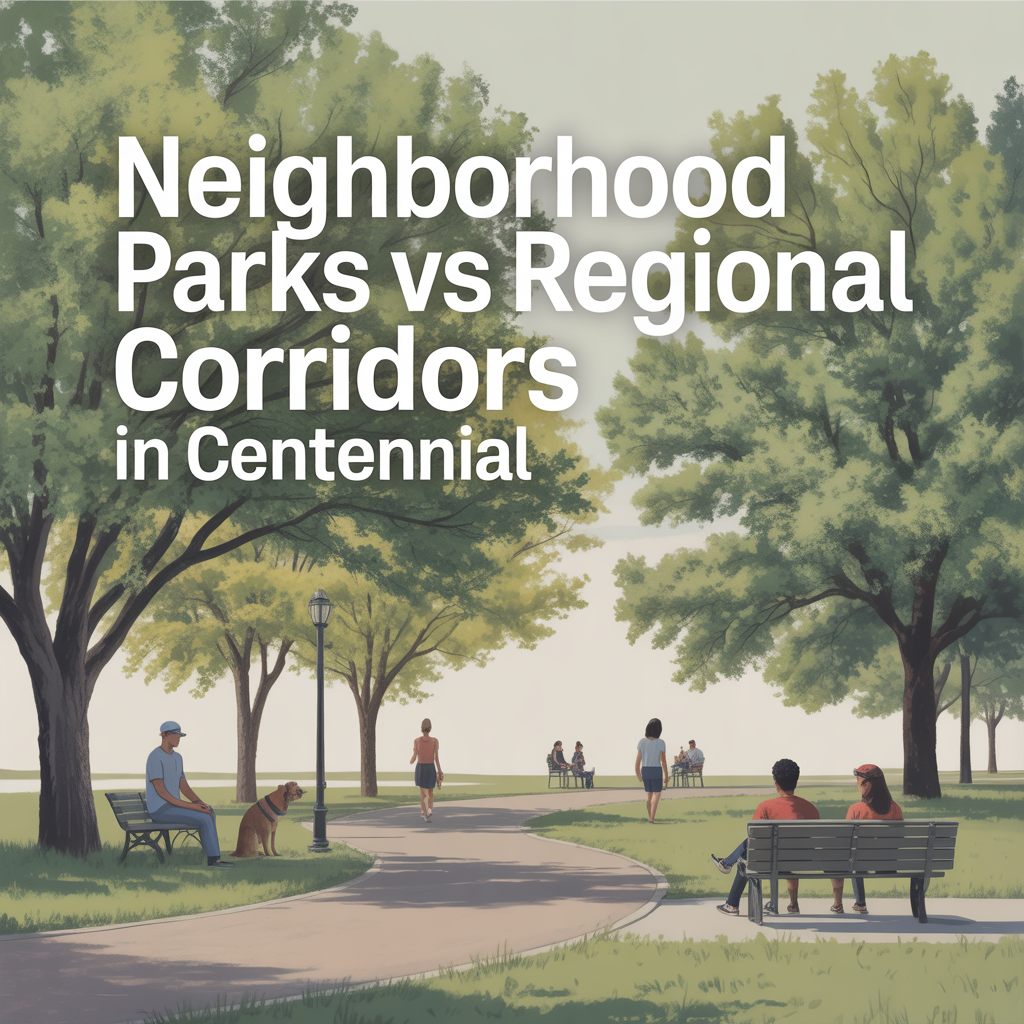
In Centennial, the way you use nearby neighborhood parks versus larger regional corridors shapes your everyday life more than most people realize. Both matter, but they serve different roles in your daily rhythm, your sense of community, and how your home “feels” over time.
What Counts as a Neighborhood Park in Centennial
Neighborhood parks in Centennial are the small to mid‑sized green spaces tucked inside subdivisions or just off collector streets. Think of Arapaho Park, Cherry Knolls Park, Foxridge Park, Hunters Hill Park, Willow Creek Park, Milliken Park, Linksview Park, and dozens of others scattered across the city. They usually have a playground, a field or two, a few courts, some paths, and maybe a loop trail of under a mile.
These parks are intentionally close to homes. Many sit within a short walk or bike ride, often reached via sidewalks, short internal paths, or small greenbelt connectors. They’re designed for everyday, unplanned use — where kids can ride over on their own, where dogs get a quick walk, and where you can step out the door and be on grass in a few minutes.
What Regional Corridors Look Like Here
Regional corridors are the bigger, continuous systems that run through and around Centennial. In practice, they include trail‑anchored greenways like the High Line Canal, Little Dry Creek, Big Dry Creek, Willow Creek, Lee Gulch, Greenwood Gulch, and the broader networks managed by districts like South Suburban Parks and Recreation and Trails Recreation District. These often connect multiple cities, cross major roads through underpasses, and tie into places like DeKoevend Park, Dove Valley Regional Park, and Centennial Center Park.
Instead of a single playground surrounded by houses, a regional corridor feels like a string of pearls — long stretches of trail, pockets of open space, and parks or nodes spaced along the route. You might access them from a neighborhood park, but once you’re on the corridor, you can go miles without stepping back onto a sidewalk or driving somewhere new.
How Neighborhood Parks Show Up in Daily Life
For most Centennial residents, neighborhood parks are the “default setting” for everyday outdoor time. They’re where you:
- Take ten‑minute breaks between Zoom calls.
- Send the kids to burn off energy before dinner.
- Practice soccer or baseball informally without booking a field.
- Do short walks when you don’t have the time or bandwidth to drive anywhere.
Because they’re small and nearby, you don’t have to plan. You can go in jeans and flip‑flops, carry a single water bottle, and be home in half an hour. Over time, these parks become emotional landmarks: where your kids learned to pump on a swing, where you taught them to ride a bike, where you chatted with a neighbor while watching dogs chase tennis balls.
They also act as casual social hubs. You see the same families at the playground, the same dog walkers at certain times, and the same teens shooting hoops in the evenings. That repetition builds quiet familiarity. It’s not the kind of “community” that shows up in marketing brochures, but it’s the kind that makes you feel known in your own neighborhood.
How Regional Corridors Shape Routine and Identity
Regional corridors show up a little differently. They tend to be part of:
- Regular runs and bike rides, especially once people settle into a favorite loop.
- Weekend “family walks” that combine exercise, conversation, and exploring beyond your own block.
- Longer dog walks where you want more scenery and less stop‑and‑go at intersections.
- Active‑lifestyle habits — hitting mileage goals, training for races, or just decompressing on longer routes.
Because these corridors cross city lines and link multiple parks, they expand your sense of home. Your mental map stops at more than just subdivision boundaries; suddenly “your area” includes miles of canal trail, creek corridor, or greenbelt you can reach from your driveway. That’s a very different way of living than needing to drive everywhere just to be around trees.
They also act as quiet commuter and connector routes for people who bike to nearby transit, schools, or recreation centers. You’ll see early‑morning cyclists, stroller‑pushing parents mid‑day, and after‑dinner walkers all using the same spine in different ways as the day goes on.
The Emotional Difference Over Time
The big difference isn’t just size — it’s how each type of space feels over years of use.
Neighborhood parks feel intimate and cyclical. You see seasons change in the same small landscape: first‑day‑of‑school photos on the same bench, first snowfall sledding on the same hill, summer sprinklers and fall leaves in the same field. You feel each small improvement — a new playground surface, fresh paint, added picnic tables — as an upgrade to your daily life.
Regional corridors feel more like a backdrop to your long‑term health and stress level. They’re where you log the quiet miles that keep your blood pressure down, clear your head after a hard day, or think through big decisions during a long walk. When people tell me they “don’t feel boxed in” despite living in the suburbs, it’s often because they have a corridor trail they can access without getting in a car, not because of a single big park.
West‑Side vs East‑Side Patterns in Centennial
Centennial is managed by multiple park and recreation districts, and that shapes how people use neighborhood parks and corridors differently across the city. Residents in the South Suburban Parks and Recreation area (largely central and west Centennial) often have dense networks of small parks, greenbelts, and trailheads, with places like DeKoevend Park, Arapaho Park, Cherry Knolls Park, and Willow Creek Park connecting straight into larger systems like the High Line Canal or Dry Creek trails.
On the eastern side, residents are more likely to interact with corridors that connect into Cherry Creek State Park, Piney Creek, or open space tied to the Trails Recreation District and Arapahoe County. Neighborhood parks still anchor routines, but the “big nature” piece often runs through those larger corridors and the state park, so the contrast between your small local park and your larger weekend routes is even more pronounced.
Understanding which district you’re in matters. It affects which recreation centers, trails, and park improvements you’ll see most often, and whether your daily life leans heavier on neighborhood parks, on corridors, or on a blend of both.
What This Means When You’re Choosing a Neighborhood
From a real‑estate and lifestyle perspective, the ideal setup is rarely “either/or.” It’s usually about finding a place where:
- You have at least one good neighborhood park within a short walk or easy bike ride.
- You can access a regional corridor within a few minutes — ideally without driving, or with a very short drive.
If you’re more home‑oriented with small kids, you may lean heavily on the neighborhood park for the next few years and only hit the corridors on weekends. If you’re a runner, cyclist, or dog‑walker, you may care much more about being near a continuous trail system and treat the park as a nice‑to‑have playground or field.
The key is being honest with yourself about your habits. Do you see yourself actually running or biking several miles regularly, or do you mostly want a safe place for kids to play and quick dog walks? Do you picture long evening walks with a partner, or short playground runs after work? Your answers should push you either toward park‑dense pockets, corridor‑adjacent areas, or ideally a neighborhood that offers both.
Using Parks and Corridors as a “Fit Test”
If you’re already here, one of the best ways to evaluate how well your current area fits you is to track where you go for 30 days. Do you default to the neighborhood park three times a week and only hit a corridor once? Or do you find yourself driving to a trailhead regularly because the local park feels too small? That behavior tells you whether your daily environment is working for you or asking more of you than it should.
If you’re thinking about moving within Centennial or into the city, walk and drive these spaces at the times you’d actually use them — early mornings, late evenings, weekends in all seasons. Notice how many kids are in the park, how safe you feel on the corridor, how easy it is to get there from a few streets you’re considering. The closer your lived routine matches what the neighborhood makes easy, the more “right” the house will feel years after closing.
If you’d like to talk through specific Centennial pockets — where neighborhood parks, district lines, and regional corridors line up with the way you actually live — I’m always happy to sit down and map it out with you. No pressure and no scripts, just a practical, local conversation about matching your next move with the daily outdoor life you want, not just the one that looks good on paper.
Get the full Denver Market Insights → [Market Insights]



Littleton’s Ken Caryl for Lockheed Relocations
This is part of Lockheed Martin Relocation → [Lockheed Martin Relocation Hub] & the larger Denver Relocation Hub → [Denver Relocation Hub] Written by: Chad Cabalka Ken Caryl is one of the best-kept “family first” relocation options for Lockheed Martin employees who want foothills scenery, strong neighborhood appeal, and a real suburban lifestyle that still feels connected…


Centennial & Parker for Lockheed Relocations
This is part of Lockheed Martin Relocation → [Lockheed Martin Relocation Hub] & the larger Denver Relocation Hub → [Denver Relocation Hub] Written by: Chad Cabalka Centennial and Parker are two of the smartest suburban choices for Lockheed Martin employees relocating with families because they give you a strong balance of commute flexibility, good neighborhood variety, and…

Highlands Ranch for Family-Friendly Lockheed Relocations
This is part of Lockheed Martin Relocation → [Lockheed Martin Relocation Hub] & the larger Denver Relocation Hub → [Denver Relocation Hub] Written by: Chad Cabalka Highlands Ranch is one of the strongest choices for Lockheed Martin employees relocating with families because it delivers exactly what most parents want after a big move: stable neighborhoods, strong community…