


This is part of Lakewood Lifestyle Guide → [Lakewood Lifestyle Hub] & Lakewood Real Estate Guide → [Lakewood Real Estate Guide]
Written by: Chad Cabalka
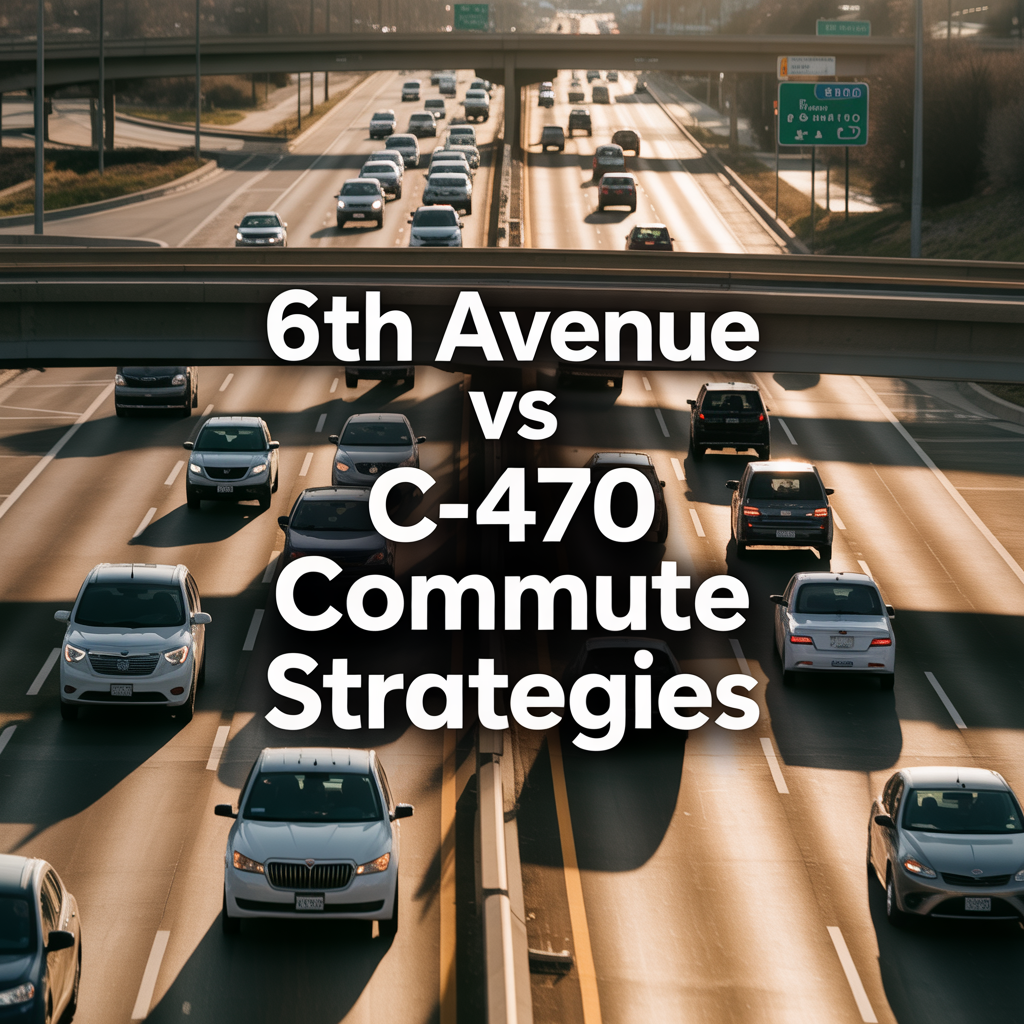
For Lakewood residents, the 6th Avenue freeway and C‑470 aren’t just lines on a map—they’re two very different ways of structuring your commute and your week. The “right” route depends less on which is faster in theory and more on where you’re going, what hours you keep, and how you want your life to feel between home and work.
What Each Road Is Actually For
6th Avenue (US‑6) is Lakewood’s straight shot into downtown Denver and back. It runs east–west, tying Golden, Lakewood, and central Denver together and feeding directly into downtown via the Colfax / Federal corridor. If your job or regular commitments are in or near downtown, the Auraria campus, or central stadium/LoDo area, 6th is your main artery.
C‑470, by contrast, is the southern and western beltway. It wraps around the southwest metro and connects to I‑25 near the Denver Tech Center, Santa Fe (US‑85), Ken Caryl, and I‑70. If you’re commuting to the Denver Tech Center, Inverness, Meridian, or linking to I‑25 or E‑470 for south/east jobs, C‑470 is usually your backbone.
A simple rule of thumb:
- Downtown / west‑Denver jobs → 6th Avenue is your primary route.
- Tech Center / south I‑25 jobs → C‑470 plus a connecting route (Santa Fe, I‑25, or Wadsworth/Hampden) tends to be your spine.
Typical Commute Times and Patterns
Pre‑ and post‑pandemic data plus local reports give a fairly consistent picture:
- Lakewood to downtown Denver via eastbound 6th Avenue from Union to Knox is about 9–11 minutes in the heart of rush hour for that key 5‑mile stretch, a bit faster than pre‑2020 and still one of the more manageable freeway commutes in the region.
- From many Lakewood neighborhoods, you’re looking at roughly 15–20 minutes to downtown using 6th when traffic is typical, especially from Belmar, Green Mountain, and central corridors.
- Commutes from Lakewood to the Denver Tech Center via C‑470 are often in the 25–30 minute range in typical conditions, especially for west/southwest Lakewood neighborhoods that can drop straight onto C‑470.
C‑470’s managed lane project, completed around 2020, smoothed out a lot of the worst stop‑and‑go segments and made travel times more reliable than they used to be. That reliability matters for people who can’t shift their work hours easily.
When 6th Avenue Makes More Sense
6th Avenue shines when:
- You’re going downtown or near‑downtown—government centers, office towers, stadiums, Auraria, or the central cultural district.
- You live in central, northern, or Green Mountain parts of Lakewood, where access to the 6th corridor is quick and mostly on surface streets.
- You can leave a bit early and return a bit early, taking advantage of the fact that 6th compresses rush‑hour time more than distance.
Pros:
- Direct, simple routing—very few decisions once you’re on.
- Quick access to both Denver and Golden, and easy jumps to I‑25 north or I‑70.
- Good for hybrid workers who only go in 2–3 days a week and can tolerate short bursts of congestion.
Cons:
- Sensitive to crashes and weather; a single incident can back up several interchanges.
- Feeds into urban surface streets—Federal, Colfax, downtown grid—so the last mile can be the most stressful.
- Noise and air quality are real considerations if you live immediately along the corridor.
From a housing angle, neighborhoods like Belmar and parts of central/east Lakewood are especially attractive for people who rely on 6th: you can reach the on‑ramps quickly without threading a dozen lights, keeping your total door‑to‑door time down.
When C‑470 Is the Better Spine
C‑470 makes more sense when:
- Your job is in the Denver Tech Center, Inverness, Meridian, or south I‑25 corridor, where 6th would require cutting across the grid and fighting I‑25 north/south traffic.
- You live in south or southwest Lakewood—Bear Creek, Solterra, Rooney Valley, or near the Morrison/Hampden corridors—where you can tap C‑470 without crossing the entire city first.
- You can leverage off‑peak or hybrid schedules, avoiding the heaviest I‑25 merge pressure around morning and late‑afternoon peaks.
Pros:
- Beltway configuration means you can angle toward multiple job centers (DTC, Lone Tree, Highlands Ranch, Ken Caryl) without running downtown first.
- Post‑construction, travel times are smoother and more predictable over much of the corridor than they were pre‑2020.
- Often easier access to southern suburbs’ park‑and‑rides and light‑rail connections if you want to mix driving with transit.
Cons:
- You still have to deal with I‑25 for final DTC access unless your job is very close to the C‑470 interchanges.
- Weather and crashes can snarl the southern beltway, especially near Santa Fe and eastern segments.
- If you live on the north side of Lakewood, reaching C‑470 can require a significant cross‑city drive, erasing its time advantage.
For buyers, this is why Green Mountain and Bear Creek areas are so appealing to workers who split time between the Tech Center and downtown/Golden—you can swing south to C‑470 or east on 6th as needed without major backtracking.
Hybrid Work and “Commute Psychology”
For a lot of Lakewood professionals now, the commute is 2–3 days a week, not five. That changes the calculus. People are often willing to accept:
- A longer but smoother C‑470 drive to the DTC a couple of days a week if it means they can live closer to trails and open space the rest of the time.
- A short, high‑intensity 6th Avenue blast into downtown if they can avoid I‑25 and know they’ll only do it occasionally.
The big shifts I see over time:
- Commute length matters, but commute reliability and stress level matter more. A predictable 30 minutes often feels better than a wild 20–45 minute range.
- People are more willing to trade an extra 5–10 minutes on the road for better neighborhood amenities—trails, parks, dining, and schools—since they spend more time near home overall.
This is where 6th vs C‑470 becomes less about pure speed and more about which corridor syncs with your broader routine.
Practical Strategy by Destination
Here’s a simple, real‑world way to think about it:
- Downtown Denver / LoDo / Auraria / Union Station
- Primary: 6th Avenue eastbound.
- Consider: light rail from Lakewood‑Wadsworth or Federal Center if your office is walkable from a central station and you dislike parking downtown.
- Golden / Jeffco offices / west‑side tech & research
- Denver Tech Center / Inverness / Meridian
- Primary: C‑470 + I‑25 or Santa Fe + C‑470 depending on your exact start point.
- Southwest Lakewood neighborhoods (Bear Creek, Solterra, near C‑470 interchanges) are ideal for minimizing cross‑city time.
- Hospital/Biomed corridors (St. Anthony, Union Boulevard, west Denver medical)
- Primary: local arterials plus short hops on 6th; you rarely need C‑470 unless you’re coming from the south.
Choosing Neighborhoods with Commute in Mind
When clients weigh 6th vs C‑470, I usually have them sketch out three things:
- Primary workplace(s): downtown vs DTC vs Golden/Union.
- Typical work hours: can you leave early and come back early, or are you locked into textbook rush hour?
- Non‑work priorities: trails, schools, dining hubs (Belmar vs Union), and open space.
Then the patterns get clear:
- If you’re firmly downtown‑oriented, central and east Lakewood near 6th (Belmar, Lakewood Country Club area, parts of Edgewater/Applewood) will usually feel best.
- If you’re split between downtown and DTC, Green Mountain, Rooney Valley, and Bear Creek areas put you near both 6th and C‑470.
- If you’re DTC‑dominant, further south and southwest Lakewood—close to C‑470 entries—tend to keep your stress lower, even if they’re a hair farther from downtown.
If you’d like to walk through your specific destinations, work patterns, and the Lakewood neighborhoods that line up best with either a 6th‑centric or C‑470‑centric life, I’m always happy to talk it through. Matching your home to the commute pattern you actually have—not the one you hope you’ll have—goes a long way toward making Lakewood feel like an upgrade, not just a different kind of traffic.
Get the full Denver Market Insights → [Market Insights]



Littleton’s Ken Caryl for Lockheed Relocations
This is part of Lockheed Martin Relocation → [Lockheed Martin Relocation Hub] & the larger Denver Relocation Hub → [Denver Relocation Hub] Written by: Chad Cabalka Ken Caryl is one of the best-kept “family first” relocation options for Lockheed Martin employees who want foothills scenery, strong neighborhood appeal, and a real suburban lifestyle that still feels connected…


Centennial & Parker for Lockheed Relocations
This is part of Lockheed Martin Relocation → [Lockheed Martin Relocation Hub] & the larger Denver Relocation Hub → [Denver Relocation Hub] Written by: Chad Cabalka Centennial and Parker are two of the smartest suburban choices for Lockheed Martin employees relocating with families because they give you a strong balance of commute flexibility, good neighborhood variety, and…

Highlands Ranch for Family-Friendly Lockheed Relocations
This is part of Lockheed Martin Relocation → [Lockheed Martin Relocation Hub] & the larger Denver Relocation Hub → [Denver Relocation Hub] Written by: Chad Cabalka Highlands Ranch is one of the strongest choices for Lockheed Martin employees relocating with families because it delivers exactly what most parents want after a big move: stable neighborhoods, strong community…