


Home Inspections Guide -> [Home Inspections Guide] & For more info on Buying in the Denver Metro Area → [Denver Metro Home Buying Process]
Written by: Chad Cabalka
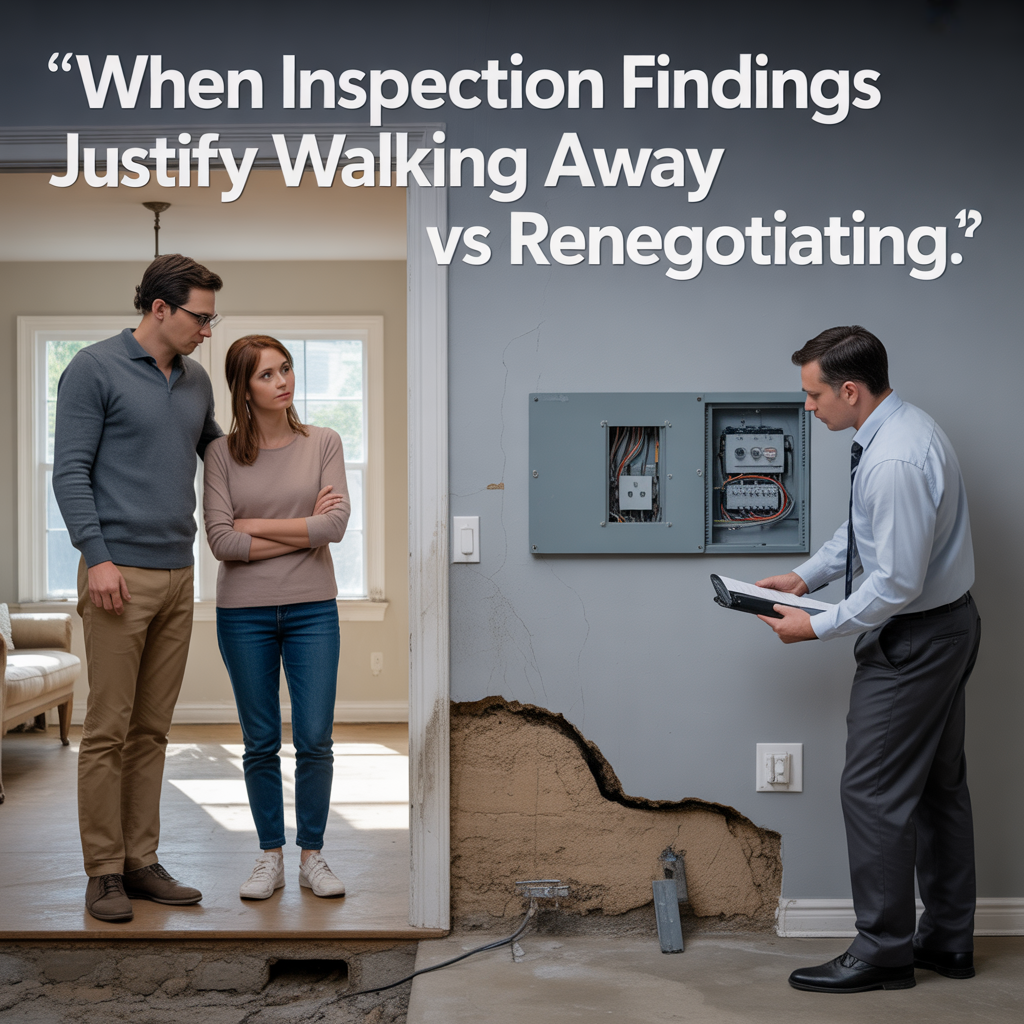
There are really two questions after an inspection in Colorado: “Can I still see myself living here, knowing what I know now?” and “Does the math still make sense if I adjust for these issues?” When the honest answer to either is no, that is when walking away — not just renegotiating — starts to make sense.
Start With Your Contract, Then Your Gut
In Colorado, your purchase contract gives you a defined inspection period and specific rights: object, renegotiate, or terminate by certain deadlines. Within that window, you can usually walk away and recover your earnest money if you follow the notice requirements, but once those dates pass, your options narrow dramatically.
So we always begin with calendar control: knowing your inspection, objection, resolution, and termination deadlines cold. Once you’re clear on the legal framework, the real work is combining that with your tolerance for risk, your budget, and how you expect this home to feel five or ten years from now, not just on closing day.
When Inspection Findings Justify Walking Away
Certain findings are so big, so expensive, or so uncertain that even strong buyers step back. Common examples include serious structural movement, widespread foundation issues, failing or ancient sewer lines with limited access, major roof failure with interior damage, or extensive hidden moisture and mold that will require invasive remediation.
You also reach the “walk” zone when multiple systems are near the end of their life simultaneously and the seller will not meaningfully adjust — think roof, HVAC, sewer line, and original electrical all needing attention within a few years on a home that already stretches your budget. Even if each item is theoretically fixable, the combined financial and emotional load can be more than is wise. In those situations, I tell clients to imagine it’s three years from now and ask, “Will I resent this house for what it took out of me?” If the answer is yes, it may be time to let it go and redirect your energy to a property that fits better.
When Renegotiating Is the Smarter Move
On the other hand, many inspection findings are exactly what contingencies are designed for: they justify a repair plan, a credit, or a price adjustment, not a full stop. Typical renegotiation territory includes: moderate roof wear, localized sewer defects that can be lined or spot‑repaired, aging HVAC that still functions but is clearly near the back half of its life, or code‑update items like GFCI outlets and handrail corrections.
In these cases, you and your agent can bring photos, contractor estimates, and a clear, written objection to the seller and say, in effect, “We still want this home, but we need the numbers to reflect what we now know.” If the seller is responsive, collaborative, and willing to share the burden in a fair way, it often makes more sense to solve the problems together than to walk away and start over with an unknown property that will have its own inspection story.
Red Flags That Tip the Scale Either Way
Sometimes it’s less about the issues themselves and more about how the other side responds. If a seller minimizes clear safety concerns, refuses even modest concessions, or becomes combative when presented with professional findings, that behavior can be its own red flag. You’re not just buying a house; you’re finishing a transaction with real people. An unwillingness to engage in good‑faith problem solving can tilt a close call toward termination, especially if the house has serious defects.
On the flip side, if the seller steps up quickly on big‑ticket, health, or safety items and is transparent about the home’s history, that cooperation can make you more comfortable staying in the deal even with a challenging report. The question becomes, “If we resolve these items on paper, does this home still fit our long‑term goals?” When the answer is yes, renegotiation is often your most efficient path forward.
Protecting Your Future Self
At the end of the day, the test I come back to with Denver buyers is simple: if all of these issues played out exactly as the inspector thinks they might, would you still feel okay about this purchase three to five years from now, knowing your budget, your tolerance for projects, and your life plans? If the honest answer is no — even after reasonable concessions — then walking away is not failure; it’s discipline.
If the answer is yes, but only if certain costs are shared or timelines adjusted, then it’s time to renegotiate with clear numbers and calm expectations. Either way, the goal is not to “win” the inspection; it’s to align the reality of this specific house with the reality of your life so you don’t carry regret into ownership.
If you’re facing a tough inspection decision in the Denver area and want a straightforward, no‑pressure second opinion, I’m always open to talk through your options — what the report actually means, where the line between walking and renegotiating might be for you, and how to protect both your finances and your peace of mind over the long run.
This is offered as general education only. If you are already under contract with another agent, nothing here is meant to override their guidance or solicit you as a client; I fully respect those boundaries and would encourage you to defer to their advice.
Get the full Denver Market Insights → [Market Insights]



Littleton’s Ken Caryl for Lockheed Relocations
This is part of Lockheed Martin Relocation → [Lockheed Martin Relocation Hub] & the larger Denver Relocation Hub → [Denver Relocation Hub] Written by: Chad Cabalka Ken Caryl is one of the best-kept “family first” relocation options for Lockheed Martin employees who want foothills scenery, strong neighborhood appeal, and a real suburban lifestyle that still feels connected…


Centennial & Parker for Lockheed Relocations
This is part of Lockheed Martin Relocation → [Lockheed Martin Relocation Hub] & the larger Denver Relocation Hub → [Denver Relocation Hub] Written by: Chad Cabalka Centennial and Parker are two of the smartest suburban choices for Lockheed Martin employees relocating with families because they give you a strong balance of commute flexibility, good neighborhood variety, and…

Highlands Ranch for Family-Friendly Lockheed Relocations
This is part of Lockheed Martin Relocation → [Lockheed Martin Relocation Hub] & the larger Denver Relocation Hub → [Denver Relocation Hub] Written by: Chad Cabalka Highlands Ranch is one of the strongest choices for Lockheed Martin employees relocating with families because it delivers exactly what most parents want after a big move: stable neighborhoods, strong community…