


Phoenix Lifestyle Guide → [Phoenix Lifestyle Guide] & For more info on Phoenix Real Estate → [Phoenix Real Estate Guide]
Written by: Renee Burke
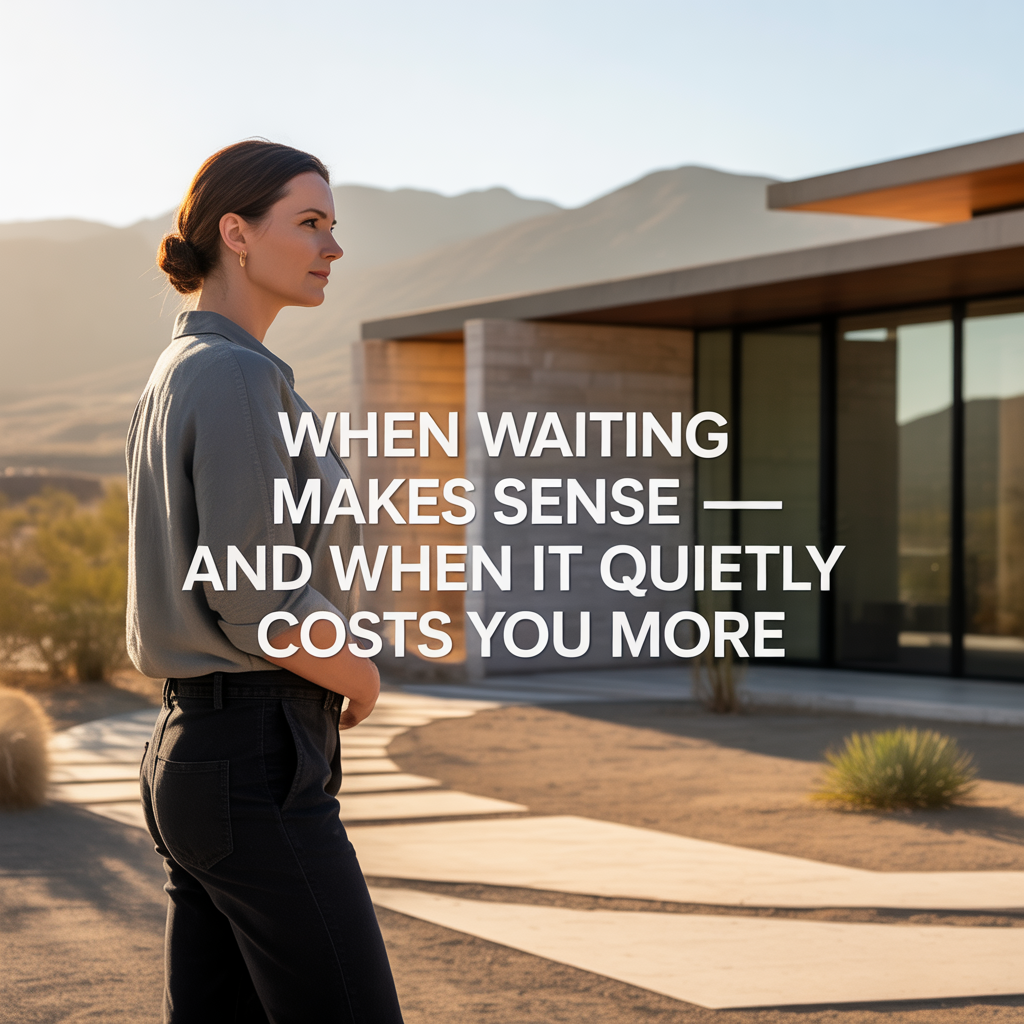
If you’ve been watching the Phoenix real estate market lately, you’ve probably said this to yourself at least once: “Maybe I should just wait.”
It’s one of the most natural thoughts when prices feel high, rates seem uncertain, or there’s too much noise about “what’s coming next.”
But waiting is rarely just neutral. In real estate—especially in a market as dynamic and fast-evolving as ours—waiting can either quietly protect you or, more often, quietly cost you. The key is understanding which kind of waiting you’re doing.
The Kind of Waiting That Makes Sense
Not all waiting is hesitation. Sometimes it’s wisdom.
Here in the Valley, there are moments when taking your time absolutely serves you:
- You’re still defining your priorities. Maybe you’re unsure if you want the bustle of downtown Tempe or the easy mornings of North Peoria. If you don’t know what lifestyle truly fits you, pausing to explore the Valley’s distinct neighborhoods can be the smartest move of all.
- Your financial foundation needs a little more time. Boosting credit from the mid-600s into the 700s can reduce your long-term costs dramatically. Even an extra few months of savings can shift your loan approval or help you secure better terms.
- Your life is genuinely in transition. If you know a job relocation, new family member, or lifestyle change is just ahead, there’s nothing wrong with keeping flexibility for a short season. Renting can sometimes buy you that breathing room.
These are purposeful forms of waiting. They’re about gaining clarity, not avoiding commitment. In a market like Phoenix—where every suburb has its own heartbeat—clarity is invaluable.
The Waiting That Starts to Cost You
The trouble begins when waiting stops being strategic and starts being emotional.
Many Phoenicians hesitate because the market seems unpredictable, or because they hear that rates “should come down soon.” But here’s the truth: waiting for the absolute perfect moment rarely works out as perfectly as it sounds.
Consider this:
In early 2024, the average mortgage rate hovered around 6.3%. Prices across the Valley dipped slightly, with average home values inched down about 2–3% in some zip codes. Many buyers held off, hoping for a bigger dip or better financing. By mid-2025, rates edged down briefly—but home prices climbed by nearly 6% across metro Phoenix as more buyers rushed back into the competition.
Those who “waited for rates to drop” often found themselves priced out by the very momentum they’d anticipated.
Here’s what that looks like in real numbers:
- In spring 2024, purchasing a $450,000 home at 6.3% meant a monthly payment around $2,800.
- In late 2025, that same home jumped to $477,000—and even if your rate dropped to 5.8%, your new payment was still about $2,850.
It’s a quiet kind of irony: waiting didn’t save money. It only reshuffled where the cost showed up.
The Local Reality Behind “Timing the Market”
Because I live and work right here in Phoenix, I see what national headlines often miss: our city never moves in lockstep with national “market cycles.”
Our growth is still fueled by job expansion—from semiconductor manufacturing in Chandler to healthcare and tech hubs stretching from Tempe to Glendale. Families and professionals are arriving every month, drawn by opportunity, sunshine, and space. That steady inbound flow keeps housing demand stronger than national averages, even when parts of the country cool off.
This means that in Phoenix, the cost of waiting often comes quietly through competition, not just price tags. A home that would have had a single offer last year may see four or five today. That kind of competition drives subtle bidding wars, waiving of contingencies, and compressed timelines that can easily add thousands of dollars—or missed opportunities—over time.
So while “waiting for the right time” sounds cautious, in the Valley it can sometimes mean waiting for prices and demand to climb past reach.
The Compound Cost of Waiting
There’s also what I call the “invisible rent factor.”
Every month a would-be buyer stays on the sidelines means another month of paying rent. At an average of $1,850 a month across Phoenix, that’s $22,200 a year leaving your pocket—money that could be building equity instead. Multiply that by two or three years, and you’ve offset much of the eventual savings from waiting for a slightly lower rate.
Even small market shifts add up faster than people realize. If home values rise just 4% a year, a $450,000 home grows by $18,000 annually. After two years of waiting, you might face a $36,000 higher purchase price — and that’s before considering rent paid or any down payment adjustments.
I often tell clients: you don’t notice the cost of waiting month-to-month, but you absolutely feel it when you look back a few years later.
The Middle Path: Waiting Wisely
That doesn’t mean you should jump before you’re ready. Smart homeownership is about readiness, not rush.
Here’s what strategic waiting can look like in today’s Phoenix market:
- Use time to prepare, not postpone. While you monitor listings, start improving your credit, explore down payment assistance programs, and interview lenders. This kind of preparation turns waiting into leverage.
- Watch neighborhoods, not just prices. Some emerging areas—like parts of Buckeye or the expanding corridors of Queen Creek—are showing long-term affordability alongside strong appreciation potential. Waiting might make sense only if it helps you buy smarter, not just later.
- Stay connected to the market. Having a trusted local advisor—someone watching shifts week-by-week—means that when the right opportunity surfaces, you’re ready to act.
The difference between losing time and using time comes down to intentionality. When you wait with a plan, the market doesn’t leave you behind—it lines up when you’re ready.
Phoenix Isn’t a Market to Fear—It’s a Market to Understand
It’s natural to feel uneasy making a big financial move when headlines talk about volatility, affordability challenges, or rising rates. But Phoenix isn’t just a dot on the national map—it’s its own living, growing ecosystem.
Unlike some markets that are shrinking or losing jobs, our region continues expanding around education, healthcare, logistics, and tech industries. That underlying strength gives homeowners here a buffer—and historically, a pathway to long-term stability.
Waiting can feel safe, but it’s often just comfortable uncertainty. Buying, when done thoughtfully, brings clarity: fixed payments, growing equity, and the satisfaction of knowing your monthly check is shaping your own future, not someone else’s.
A Warm Note to Close
If you’re thinking about buying in Phoenix and trying to decide whether to wait or move forward, know this: every person’s timing is different. You don’t need to rush, but you also don’t have to guess. There’s a way to move forward carefully, confidently, and strategically.
That’s what I love helping people do. Whether you’re six months away from buying or simply exploring what’s realistic for you this year, I’m here to help you see the real landscape—and make decisions that fit your life, not a headline.
If you’re considering a move in Phoenix, you don’t have to figure it out alone. Let’s talk through your situation, your numbers, and your timing together—without pressure, just honest, local guidance from someone who’s walked this path many times before.
Get the full Phoenix Market Insights → [Market Insights]


-

Dog and Kid Friendly Parks Chandler
-

Best Chandler Parks for Regular Use
-

Trail Systems That Fit Chandler Life
-
Active Parks vs Passive Greenspace Chandler
-

Daily Outdoor Habits by Chandler Area
-
Map vs Usable Parks in Chandler
-

Weekly Go‑To Spots Around Chandler
-

Local‑Favorite Restaurants in Chandler
-

Hosting at Home vs Going Out Chandler
-

Family‑Friendly vs Nightlife Zones Chandler
-

How Late Chandler Areas Stay Active
-

Walkable Chandler Dining and Nightlife Pockets
-

Spontaneous vs Planned Dining in Chandler
-

Chandler Feeder Patterns and Predictability
-

District vs Charter Tradeoffs in Chandler
-

Weekend Events Around Chandler Schools
-

After‑School Sports and Activities Chandler
-

Parent and Community Networks in Chandler
-

Family Morning and Evening Routines
-

School‑Day Traffic in Chandler
-

Heat and Microclimates in Chandler
-

Airport and Freeway Proximity Within the East Valley
-
Dining Density by Chandler Corridor
-

Real Outdoor Access by Chandler Area
-
Commute Corridors and Directions in Chandler