


Tempe Lifestyle Guide → [Tempe Lifestyle Guide] & Tempe Real Estate Guide→ [Tempe Real Estate Guide]
Written by: Renee Burke
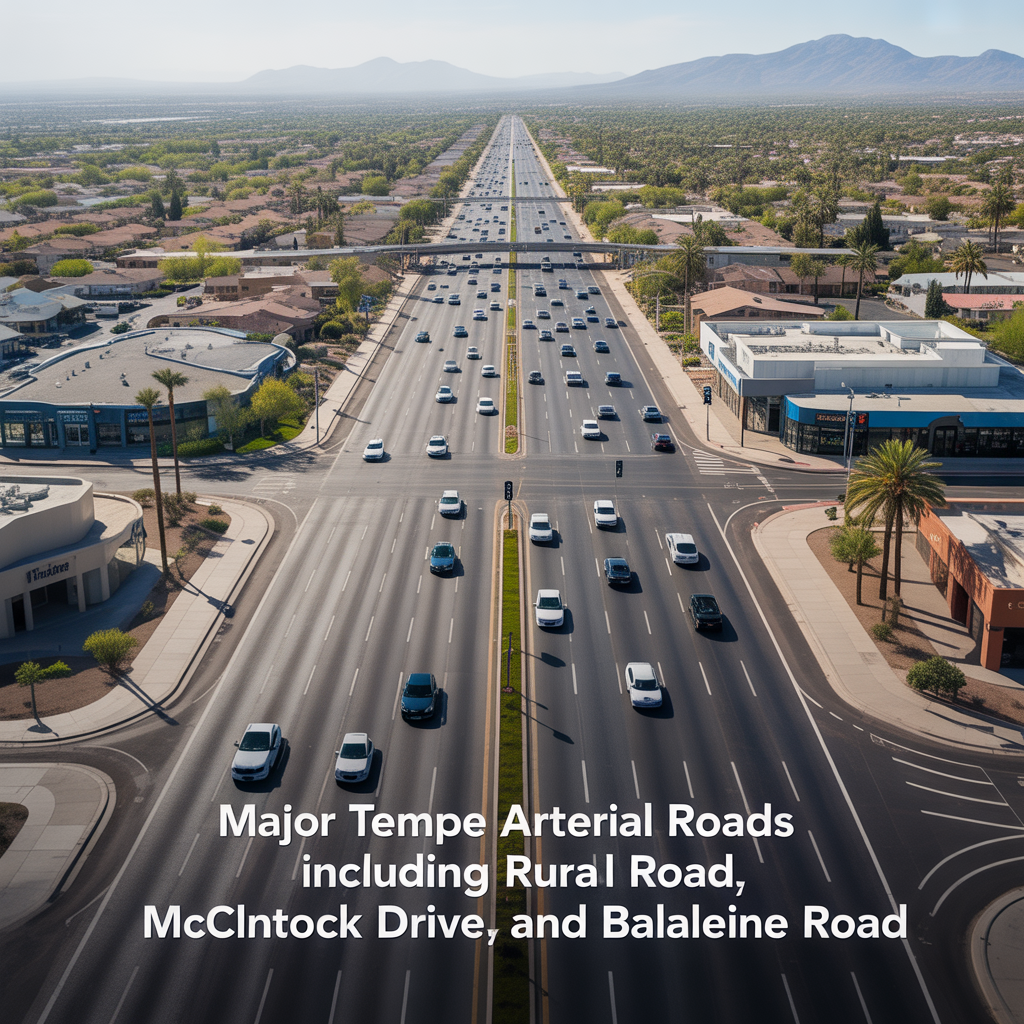
If you’ve lived in Tempe for even a short time, you know how the rhythm of the city flows around a few major corridors. The roads we take every day shape not just our commutes, but also our communities, convenience, and even our real estate decisions. Three of Tempe’s most defining arterial roads—Rural Road, McClintock Drive, and Baseline Road—each have their own distinct character and influence on how this vibrant East Valley city moves and grows.
As someone who’s worked and lived around Tempe for many years, I’ve learned that understanding these roads isn’t just about traffic flow. It’s about understanding how Tempe breathes—where growth is heading, which neighborhoods are quietly maturing, and where convenience meets livability. For homebuyers and investors, these aren’t just street names on a map. They are subtle but powerful indicators of value, lifestyle, and connection.
Rural Road: The Academic Spine of Tempe
Rural Road begins its story at the heart of Tempe’s identity—Arizona State University. Stretching north to south through the city, Rural serves as both a defining boundary and a living artery that carries the pulse of the college town atmosphere.
North of University Drive, things move quickly. You’ll find a blend of modern student housing, campus-adjacent condos, and revitalized commercial spaces that cater to the constant cycle of students, faculty, and local professionals who thrive on proximity to ASU. Traffic can be brisk, yes, but that energy is part of what makes north Tempe feel alive and forward-looking.
A little farther south, around Apache Boulevard and Broadway Road, Rural Road becomes more transitional. Here, you’ll see a swirl of redevelopment projects—older mid-century homes being refreshed, small apartment complexes adding modern touches, and local eateries drawing regulars who prefer authentic over trendy. For buyers, this stretch signals opportunity: neighborhoods that are still moderately priced but poised for appreciation as Tempe’s redevelopment ripples outward from downtown.
By the time you reach Southern Avenue and Baseline Road, Rural Road takes on a calmer, more family-oriented tone. The houses are typically single-story ranch or block construction, shaded by mature trees that have watched decades of growth. It’s here that you can sense a generational rhythm—families who’ve settled, neighbors who actually know each other, and a pace that’s distinctly Tempe but less hurried than its college-core counterpart.
From a real estate standpoint, homes along and near Rural Road often appeal to buyers who want city access without urban chaos. For investors, rental demand remains steady due to the proximity to ASU and central Tempe amenities. For owner-occupants, it’s the sweet spot between convenience and community.
McClintock Drive: Suburban Stability with Hidden Convenience
Just east of Rural Road lies McClintock Drive—a quieter, more balanced avenue that represents Tempe’s mid-century suburban expansion. If Rural Road shows Tempe’s youthful energy, McClintock reflects its maturity.
Starting near the northern end at the Salt River bed, McClintock serves neighborhoods that feel comfortably established. Here you’ll find The Lakes, McClintock Manor, and other communities that celebrate mid-century architecture blended with contemporary upgrades.
McClintock’s identity is built around predictability and ease. Its intersections—Broadway, Southern, Baseline, and Elliott—each anchor small, accessible shopping centers where you can still grab a morning coffee and chat with the barista who remembers your name. The light rail’s eastern extension, which runs along Apache between Rural and Price, has improved commute options for residents who work downtown or in Midtown Phoenix—something increasingly important for those drawn to urban access but suburban comforts.
For families or professionals who value balance, homes along McClintock Drive corridor represent classic Tempe living—affordable enough to make entry feasible, yet surrounded by top-rated schools, robust infrastructure, and a mix of traditional and renovated homes. Many properties here have generous lots and block fencing—appealing traits for longtime Valley homeowners who prioritize durability and privacy.
Real estate dynamics along McClintock often move in step with Tempe’s steady appreciation rather than dramatic spikes. That’s a good thing for stability-minded buyers or investors seeking reliable long-term growth. Unlike some rapidly gentrifying pockets closer to downtown, neighborhoods around McClintock retain a sense of local identity that isn’t lost in transition.
Baseline Road: The Transitional Crossroads of Tempe
Baseline Road cuts across Tempe’s southern edge, linking everything from bustling South Mountain views on the west to Dobson Ranch and Knoell Tempe neighborhoods toward the east. It’s one of the few cross-city arteries that feels equally connected to both history and change.
Originally a border between city and farmland, Baseline has evolved alongside Tempe’s expansion southward. The Rural–Baseline intersection is particularly notable—close to Ken McDonald Golf Course, beautiful neighborhood parks, and a variety of mid-1970s to early-1980s homes that have aged gracefully with the climate and culture. Baseline serves as a thread connecting different lifestyles: retirees in quiet cul-de-sacs, young professionals in updated townhomes, and long-term families rooted in the same street for decades.
What makes Baseline remarkable is its blend of accessibility and serenity. While it offers a straight drive to AZ-101 and I-10, you still pass tree-lined neighborhoods, walking trails, and quick connections to Ponderosa Park and Kiwanis Park—one of Tempe’s most beloved recreational spaces.
In real estate terms, Baseline marks a natural transition zone. North of it, prices tend to rise slightly with closer proximity to ASU and downtown Tempe. South of it, you start finding homes that offer more space for the money, appealing to buyers who want square footage and yards without pushing into Chandler or Mesa. It’s the kind of corridor where smart buyers quietly find homes that blend affordability with lasting neighborhood quality.
Lifestyle Connections: The Invisible Network of Daily Comfort
Every city has roads that do more than move cars—they connect lives. In Tempe, Rural, McClintock, and Baseline are those quiet constants that shape daily life more than most realize.
If you’ve ever timed your drive to catch fewer lights between Southern and Broadway, or turned off Baseline early to hit a favorite back route near the canal, you’re already part of that local rhythm. These streets tell stories: of morning commutes past blooming trees, of weekend farmers markets at Clark Park or Kiwanis, of kids biking to school in neighborhoods built decades before the Loop 202 ever existed.
For buyers moving to Tempe from elsewhere in the Valley, understanding how these arterial roads frame the city helps narrow the search for “that perfect pocket.” Most newcomers quickly notice that Tempe’s best features—its convenient grid layout, abundant parks, and mix of old and new—are all anchored by these steady corridors.
Local accessibility directly affects property values here. A home that sits just east of McClintock, for instance, often commands slightly more than one west of Rural—not because one is “better,” but because of differences in traffic, proximity to key destinations, and neighborhood pedigree. These small factors matter, especially in Tempe, where each subdivision has its own quiet personality.
The Real Estate Perspective: Timing and Value in Tempe’s Core
When you follow Tempe’s growth patterns closely, you start to see that roads tell real estate stories before the data ever does.
Rural Road’s ongoing revitalization near Apache signals continued student and tech spillover. McClintock’s mid-zone appeal attracts those seeking post-pandemic balance—access without intensity. And Baseline’s mature subdivisions are seeing renovation activity that mirrors what once started north near ASU a decade ago.
For homebuyers, this means there’s no single “best” part of Tempe—only better fits based on your rhythm of life. Do you want quick access to downtown dining and public transit? Rural’s your friend. Prefer quiet family streets near neighborhood schools? McClintock’s your anchor. Want yard space and easy cross-Valley commuting? Baseline gives you that and more.
A Thoughtful Close
Tempe’s arterial roads aren’t just connectors—they’re familiar paths that quietly define how people live, work, and thrive here. Whether you’re buying your first home, exploring an upgrade, or simply trying to understand the city’s layout a bit more deeply, knowing these corridors helps you see Tempe the way locals do: as a woven community, not just a grid of streets.
If you’re thinking about buying or selling in Tempe—or if you’re simply trying to get a feel for where your lifestyle fits best—I’d love to be your local guide. Every road here tells a story, and sometimes you just need someone who knows how to read the map.
If you’re thinking about making a move in Tempe, you don’t have to figure it out alone. Let’s talk through your goals, timing, and next steps—together we can find the space that truly fits your life.
Get the full Phoenix Market Insights → [Market Insights]


-
Cost of Living in Rhode Island: Housing, Taxes, Utilities, and Everyday Expenses
-

What If My Commute Becomes Worse Than Expected?
-
How Aging Home Systems Affect Property Value